Meeting to Analyzing the Concept with the Case Study of the Twelve-Day War, July 26, 2025 -
The original text is in Persian and the following translation was done by Ai.
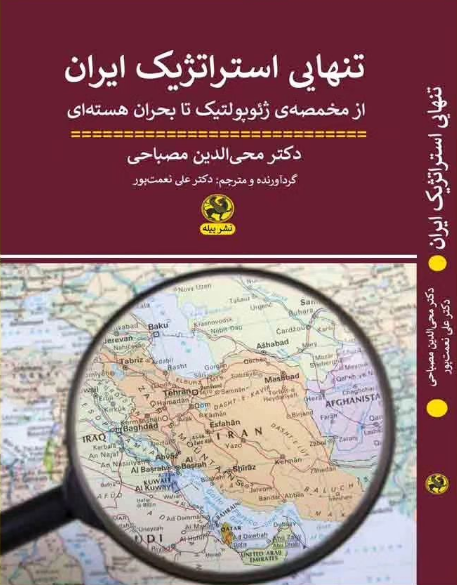
In this meeting at the Faculty of World Studies, following the sixth season of the Faculty Reading Club (J Club), in which we had reviewed the book Strategic Solitude of Iran, written by Dr. Mohieddin Mesbahi, we explored this idea, especially with the example of the imposed Twelve-Day War.
The speakers of this meeting were Dr. Jahangir Karami, Professor of the Faculty of World Studies, Dr. Mehdi Ahouei, Professor of the Faculty of World Studies and Deputy Research Director of the Iranology Foundation, and Professor Kourosh Ahmadi, retired diplomat and researcher of contemporary Iranian history and international relations. A significant number of students attended the meeting virtually and in person.
The audio of the meeting on YouTube

******
Mr. Kourosh Ahmadi's speech, reported by Eco Iran:
"Iran's Strategic Isolation"; A Curse of Geography or a Made-Up and Self-Determined Choice
The former Iranian diplomat at the United Nations and an analyst of international affairs believes that strategic isolation means the lack of an ally or a friend who can be relied on in times of crisis, especially in situations of armed threat. Since this type of isolation makes sense in the context of strategy, the presence of a human factor and an agent is also necessarily included in this discussion.
According to Eco Iran, "Kourosh Ahmadi", a former Iranian diplomat at the United Nations and an analyst of international affairs, said at the meeting "Iran's Strategic Isolation: Analyzing the Idea of Iran's Strategic Isolation with the Example of the Twelve-Day War" held at the Faculty of World Studies, University of Tehran: "Strategic isolation is a made-up and self-determined thing. That is, a country, consciously or unconsciously, has adopted policies that result in a state of isolation and loneliness. Here we can mention North Korea. In the East Asian region, South Korea is one of the few countries that has a formal defense treaty with the United States. Japan, which is also located in the same region, is within the framework of a military alliance with the United States and benefits from its nuclear umbrella. But North Korea does not enjoy such support and is strategically isolated.”
According to IRNA, the full text of Kourosh Ahmadi’s speech is as follows:
Regarding “strategic isolation,” this discussion has been widely raised in Iran in recent years; to the extent that we have not witnessed such a wide range of discussions about it anywhere else in the world. References to this issue have also been made from time to time in relation to other countries, but it is in no way comparable to the volume and depth of discussions that have taken place under this title in Iran.
In addition to the idea of strategic isolation, there is another idea that can be called “geopolitical isolation.” However, in Iran and in the discussions that have been going on about this issue, this concept has been less addressed.
If we want to define strategic loneliness in a simple way, based on the research conducted, including the works of Dr. Mesbahi and Mr. Raisi-Nejad, we can say: Strategic loneliness means the lack of an ally, or the lack of a friend who can be relied on in times of crisis, especially in situations of armed threat. Since this type of loneliness makes sense in the context of strategy, the presence of the human factor and the agent also necessarily enters this discussion. In the sense that this situation is not necessarily the product of geographical or historical or identity constraints, but rather the result of choosing and designing a strategy by the agents of a political system.
Strategic loneliness means the lack of an ally, or the lack of a friend who can be relied on in times of crisis, especially in situations of armed threat. This situation is not necessarily the product of geographical or historical or identity constraints, but rather the result of the choice and design of a strategy by the agents of a political system. In contrast, geopolitical isolation refers to the geographical location of a political unit; in which region the country is located, whether it has friends and allies around it, and whether it can count on them against regional threats. It is also necessary to examine whether the region in which the country lives is peaceful or subject to permanent and structural tensions.
Therefore, strategic isolation is a constructed and self-willed matter. That is, a country, consciously or unconsciously, has adopted policies that result in a state of isolation and loneliness. Here we can mention North Korea. In the East Asian region, South Korea is one of the few countries that has a formal defense treaty with the United States. Japan, which is also located in the same region, is within the framework of a military alliance with the United States and benefits from its nuclear umbrella. But North Korea does not have such support and is strategically isolated.
Another example can be found in France during the era of General de Gaulle. At that time, France showed greater independence from NATO and the United States and even withdrew from the unified command of NATO. Or, for example, Finland and Sweden: before Finland joined NATO, a kind of constructed loneliness could be observed in Finnish foreign policy; an isolation that was the product of that country’s specific political choices.
In contrast, in the discussion of geopolitical isolation, we can cite the situation of India as an example. India is neighboring Pakistan in the west and China in the east; two countries that have always been either serious rivals of India or have been in a state of confrontation with it for the past 70 to 80 years. In such a situation, we can talk about a kind of geopolitical isolation for India. Or about North Korea, it should be said that this country is suffering from both strategic and geopolitical isolation. The same is true for Serbia and Israel. Israel, due to its being surrounded by Arab countries, is a clear example of geopolitical isolation.
But before we address Dr. Mesbahi and Dr. Raisi Nejad’s readings of these concepts, I need to emphasize one point: In my opinion, neither strategic isolation nor geopolitical isolation is a permanent and unchangeable situation. This is very important. Even geopolitical isolation, despite being based on geography, cannot be permanent.
The reason for this lies in the very concept of geopolitics. Geopolitics is the interaction of geography and politics. This politics results from the “policy choices” of a political system at a specific point in time, which itself is influenced by geographical features. But these choices change from system to system, from period to period, and from situation to situation. As a result, geopolitics also changes.
Neither strategic isolation nor geopolitical isolation is a permanent and unchangeable situation. This is very important. Even geopolitical isolation, despite being based on geography, cannot be permanent. For example, the end of the Cold War had a tremendous impact on global and regional geopolitics. Or changes in hostile relations between countries; After the 1958 Iraqi coup and the rise to power of Abdul Karim Qassem, Iran entered a period of hostility with Iraq that reached the brink of war in the 1970s. This hostility also led to war during the Islamic Republic. However, subsequent developments in Iraq transformed the power structure and caused a change in the geopolitics of the region.
Or, for example, the economic development of the Gulf Cooperation Council countries, especially the UAE and Saudi Arabia, in recent decades has had a direct impact on the geopolitics of the region. Changes in military strategies, ideological developments, and changes in theoretical trends are also among the factors that change geopolitics.
His understanding of strategic isolation is based on its construction. Focusing on the period after the Islamic Revolution and the foreign policy of the Islamic Republic of Iran, he believes that policies such as the slogan "neither East nor West", the lack of alliances with trans-regional powers, and the inability or unwillingness to create military alliances with regional countries have pushed Iran towards a kind of strategic isolation. This analysis is neither based on geographical determinism, nor historicism, nor civilization. Although it is not devoid of geopolitical elements, its main focus is on resistance activism. In Dr. Mesbahi's view, the strategic culture of Ashura, reliance on the axis of resistance and aligned groups, and lack of reliance on the East and West are the main reasons for Iran's strategic isolation. He proposes three components: first, military power and a coercive approach; second, social norms that are reflected in the culture of Ashura; and third, economic development, in which Iran is weak. Therefore, the focus of Iran's foreign policy has been more on the first and second components. Overall, his analysis provides a reliable theoretical framework for understanding the foreign policy of the Islamic Republic of Iran.
However, Dr. Arash Raisi-nejad’s reading is completely different. He presents an essentialist, Irano-centric analysis based on geographical determinism. He is clearly influenced by the thoughts of the late Seyyed Javad Tabataba’i, who emphasized Iranian exceptionalism and the need for a specific theorizing for Iran.
Mr. Raisi-nejad generalizes Iran’s strategic isolation throughout Iranian history and considers it based on the “curse of geography.” In a recent article, he uses this expression many times and sees Iran in a situation that is “close to danger.” He is referring to the presence of powers such as the Soviet Union, Russia, or the United States in Iran’s vicinity. According to him, Iran has always been a victim of foreign aggression due to its difficult and vulnerable geography.
In addition, Mr. Raisi-Nejad adds cultural-identity factors to this analysis: being Persian, being Shiite, and living among Turks, Arabs, and Sunnis are, in his opinion, factors that have contributed to Iran’s strategic isolation. As a result, Iran’s support for resistance-oriented groups abroad is an attempt to counter this isolation and create strategic depth.
In sum, the fundamental difference between these two perspectives is that Dr. Mesbahi’s analysis provides a theoretical and analytical framework for examining the foreign policy of the Islamic Republic of Iran, while Mr. Raisi-Nejad’s analysis is a static, essentialist, and historicist narrative of Iran’s destiny; a narrative that explains strategic isolation not as a political choice, but as Iran’s inevitable historical and geographical destiny.
Eco Iran Report

******
Speech by Dr. Jahangir Karami, IRNA:
Loneliness in the international system is neither an honor nor an obligation/ Iran and the necessity of conceptualizing a regional order
Tehran-IRNA- Professor of International Relations at the Russian Studies Department of the Faculty of World Studies said: "In the 21st century, we cannot simply play with the 20th century model. In a world where even great powers are looking for reliable partners and long-term cooperation networks, loneliness is no longer an honor nor an obligation; rather, it is a warning that must be taken seriously."
According to IRNA's foreign policy correspondent, "Jahangir Karami," Professor of International Relations at the Russian Studies Department of the Faculty of World Studies at the University of Tehran and a member of the Scientific Council of the Institute of Iran and Eurasian Studies (IRAS), said at the meeting "Iran's Strategic Loneliness; Analyzing the Idea of Iran's Strategic Loneliness with the Example of the Twelve-Day War" held at the Faculty of World Studies at the University of Tehran, "When we look at history more closely, we realize that Iran has always tried to reduce its strategic loneliness by finding allies. During the Qajar era, after heavy defeats from Russia, Iran turned to France and during the era of Nasser al-Din Shah, it became close to Germany for a while. During the Pahlavi era, it also leaned first to Britain and then to America. All these examples show that Iran has never considered isolationism a desirable strategy and has always tried to get out of it.”
Iran’s foreign policy since 1978 has been a special policy that bears little resemblance to the policies of about 206 known countries in the world; in this regard, I refer to the memoirs of “Vladimir Kozichkin,” one of the senior KGB officers in Iran, who writes: “In 1978, when the revolution took place and early 1979, we went to meet Imam Khomeini with the Soviet ambassador three times. The first time, the Imam heard the ambassador’s speech, in which he proposed the Soviet Union’s full support for the Iranian revolution. Imam Khomeini thanked him. The second time we went, the ambassador repeated the offer, but the Imam did not respond and only said, “Goodbye.” The third time, in early 1979, the Imam did not even want to meet with the ambassador.” He says, “It was very surprising to us. Because wherever in the world someone took a stand or raised a slogan against America, they usually welcomed our support, but he (Imam Khomeini) did not welcome it at all.”
Later, in his memoirs, he explains how the Islamic Revolution of Iran took a stand not only against America, but also against the Soviet Union; the “neither East nor West” policy that friends also mentioned. The 8-year war itself and Iran’s transformation into a major power in the region, without effective foreign support and under international pressure and sanctions, have caused Iran’s foreign policy to be considered truly special by a significant portion of analysts.
Iran has been left alone in the regional order not by its enemies, but also by its friends. That is, what we call “loneliness” is not simply the product of confronting historical enemies such as America, Israel, or Britain, but sometimes even countries that ostensibly stand by us have abandoned Iran in critical moments. This proposition leads us to the concept of “geopolitical loneliness,” but conceptualizing foreign policy in a broad sense is not an easy task. Perhaps no one in Iran had addressed it coherently before Dr. Mesbahi; although I do not think he himself made such a claim. It is mostly the readings and perceptions of his audience that have shaped this claim. I wish he were more present in Iran like he used to be so that we could have a direct conversation with him. Before him, Dr. Ruhollah Ramezani, may God have mercy on him, was a unique person. A member of the US National Security Council and the Council on Foreign Relations, he was someone who could be said to have inspired or greatly benefited from the majority of books written later on Iran's foreign policy.
He proposed the concept of a "kaleidoscopic" or "multifaceted, multifaceted, colorful" foreign policy. However, "colorful" is not in a negative sense, but in a diverse sense; that is, Iran's foreign policy is bound to respond simultaneously to a wide range of international issues. He generalizes this concept from the Safavid period to the end of the Pahlavi period. After him, no one has proposed this concept for the entire foreign policy of Iran over a long period. For example, the late Dr. Azghandi only deals with foreign policy during the Pahlavi period and calls it a puppet state or distinguishes discursive divisions for different periods. Therefore, macro-conceptualization in foreign policy is an interesting topic and to some extent consistent with the conditions of our day.
In the recent 12-day war, we also saw that apart from diplomatic statements and expressions of regret or sometimes verbal support, some interesting events took place. For example, the Pakistani government, although it supported Iran in words, warned the Iranian ambassador not to launch a missile towards Saudi Arabia, because Pakistan has a defense treaty with Saudi Arabia and in that case, it would be forced to react. This is the same "loneliness" that has found concrete expression.
Our dear colleague, Dr. Nematpour, points out that the concept of “strategic isolation” was introduced in a security conference in Pakistan in the mid-1980s. Although I did not see who specifically introduced this concept, it was mentioned in an interview. Dr. Raisi Nejad played a very important role in explaining this issue. When I was searching, I saw that about 30 articles, reports, and interviews have been written about this issue in the last ten years and published in newspapers, magazines, and other sources. This concept has been widely used in Iranian foreign policy literature.
The important point is that the interpretations of this concept have gone far beyond the author’s original intention. In the following, I will both explain and criticize it. A solution must also be presented. Here we are faced with related concepts that we must first clarify. For example, what is “strategic”?
In most cases, anything trivial is called strategic, such as the “strategy of the Ministry of Agriculture,” while strategic in its specific sense means a matter related to the government in the field of national security, over a long period of time, and in a competitive military environment. If these four elements are not present, it cannot be called strategic. But what is being discussed in Iran’s “strategic isolation” is the lack of “alliance.” An alliance means that two or more countries have a common threat and have an agreement and a practical mechanism to counter it.
For example, Israel is a common threat to many Muslims, but there is no will to counter it, no agreement, and no joint action, and as a result, no alliance is formed. A military alliance is not an alliance. Alliances are usually short-term and ad hoc. A strategic partnership is something between Iran and Russia, for example. Strategic here is in its general sense.
In the Iran-China agreement signed five years ago, it is titled “strategic agreement,” but there is no clause about a military alliance. Or so it is with the Iran-Russia agreement. Here it should be noted that “alliance” is subject to mutual acceptance and creating opportunities for the other side. Now we have to see in today’s international environment, is there any possibility of a strategic alliance for Iran?
In Dr. Mesbahi’s book, only one article deals with this issue, titled “Free and Bound: Iran and the International System.” The article, which is less than ten lines long, is devoted to the issue of strategic isolation and is more concerned with Iran’s possibilities and limitations in the international system. The second article in the book discusses trust in Iran-US relations, which is not very relevant to our topic, “strategic isolation.” The third article is about China and the proliferation of nuclear weapons. The fourth article is a valuable interview that is useful for those who are familiar with the theoretical foundations of international relations, because without that background, it may be misleading.
In the Iran-China agreement signed five years ago, it is titled “Strategic Agreement,” but there is no clause about military alliance in it. Or in the Iran-Russia agreement, it is also like this. Here, it should be noted that “alliance” is subject to mutual acceptance and creating opportunities for the other side. Now, we have to see in today’s international environment, is there any possibility of strategic alliance for Iran? In total, only one article is directly related to the topic we are discussing. It is noteworthy that in this article, Dr. Mesbahi has only discussed the concept of “strategic isolation” in a few lines. The title of the article states that the state was born with strategic isolation in 1979, following hostile relations with the United States. That is, they consider this strategic limitation to have existed since the Islamic Revolution and do not believe much in its existence in pre-revolutionary history.
The abstract of the article states that three basic elements are effective in Iran’s relations with the international system:
1. Political and military isolation against the United States, which, despite all the pressures, has led to a kind of acceptance of Iran into the international order, albeit reluctantly.
2. Iran’s role as a revisionist and anti-hegemonic actor in the normative and social spheres, which suggests a third way of resistance to the liberal capitalist system; a way derived from the culture of Ashura, the legacy of leftism, and transnational capacity-building.
3. Economic and developmental vulnerability, which, according to the author, is the main node of Iran’s weakness in the international system.
This article emphasizes that the center of gravity of Iran’s foreign policy in the current situation is domestic legitimacy; a legitimacy whose continuation depends on economic development and maintaining normative legitimacy through a kind of nationalism and Ashura culture. This conclusion is very consistent with our current conditions and, especially in the final section of the article, provides a clear answer to the current situation of the country.
The author also emphasizes the weakness of strategic governance; a governance that should be future-oriented, not simply postponing today’s issues. Phrases such as "imbalances" and "postponement of decisions" support this criticism. Instead of the term "moment of destiny," the author uses the term "paradigm shift" and says: Iran is on the verge of a historic choice; it will either be accepted into the international order or it will be left behind.
This article quotes Barbara Slavin from a 2011 interview with Shirin Hunter. Hunter said that Iran is strategically isolated. This statement later gained more meaning, and Dr. Raisi Nejad played a major role in expanding its meaning. Over the years, she has published more than 30 articles, analyses, and interviews on this topic, the most important of which are the article “Iran’s Strategic Isolation: From Regional Overexpansion to Regional Acceptance” and the article “Historical Strategic Isolation” (published in 1402). In these articles, Dr. Raisi Nejad emphasizes that Iran’s strategic isolation is not just a post-revolutionary phenomenon, but also existed in various forms during the Qajar and Pahlavi eras. Countries that claimed cooperation and alliance with Iran did not actually take any action to support Iran. Dr. Raisi-Nejad has analyzed this approach from the perspective of “constructivism.”
But there are also several important criticisms:
First criticism: Many historical and geographical propositions are general and cannot be proven or disproved. For example, recently, in one of the specialized foreign policy groups, someone wrote that “in the last 200 years, Iran has never played a role in determining its rulers.” But it suffices to ask: Has it really played no role at all during all this time? Yes, in some cases, we can mention the coup of 18 Mordad or 1299, but these were also accompanied by internal contexts; including the presence of military forces, educated people, clerics, and various segments of society.
So propositions of this kind, despite their apparent appeal, are not very provable. What makes these propositions is a combination of geography, history, and strategic culture. But when we look back at historical facts, we see that Iran had several conflicts with the Ottomans during the Safavid period and interacted with European powers to contain them. During the Qajar period, before America entered the world’s foreign policy, Iran sent an ambassador to this country, hoping to gain leverage against Russia and Britain.
During the Napoleonic period, Iran also interacted with the French and then showed a friendly attitude towards the Germans, because it has always sought to find an “ally,” and this is contrary to the assumption of permanent strategic isolation. The need for an ally was felt strongly, especially in the face of British and Russian pressures.
But when we look at history more closely, we find that Iran has always tried to reduce its strategic isolation by finding allies. During the Qajar period, after heavy defeats from Russia, Iran turned to France and during the reign of Nasser al-Din Shah, it became closer to Germany for a while. During the Pahlavi era, it also leaned first to Britain and then to the United States. All these examples show that Iran has never considered isolation as a desirable strategy and has always tried to get out of it.
This issue, that is, the constant effort to find an “external ally”, clearly shows that strategic isolation is not only Iran’s natural situation, but also an imposed and sometimes temporary situation that Iran has been forced to endure in the face of the global order. Sometimes this isolation is due to pressure from great powers and sometimes the product of internal inefficiencies.
Iran’s role should not be based solely on military deterrence or ideological ties, but should include a combination of soft power, cultural diplomacy, and economic participation. Dr. Raisi Nejad points out an important point in one of his works: Iran has been left alone in the regional order not by its enemies, but also by its friends. That is, what we call "loneliness" is not simply the product of confrontation with historical enemies such as America, Israel, or Britain, but sometimes even countries that ostensibly stand by us have abandoned Iran in critical moments.
This proposition brings us to the concept of “geopolitical isolation”; an isolation that is not only caused by the overt hostility of Western powers, but also by the lack of a stable network of allies in the region. In major crises – including in Syria, Yemen, Afghanistan, and now in the Palestinian issue – many actors who were expected to side with Iran have either remained neutral or have effectively sided with the other side.
In such circumstances, Iran’s strategy to counter this isolation has been to expand its strategic depth in the region. But this expansion itself has raised questions:
• Has Iran’s increased regional influence led to a reduction in strategic isolation?
• Has Iran’s soft power been able to provide sustainable regional legitimacy alongside its hard power?
• Do Iran’s regional audiences have the same image of Iran that the Islamic Republic’s foreign policy apparatus cultivates in its mind?
The answers to these questions are complex. There is evidence that Iran’s strategic depth in some areas has met with resistance or serious doubts from host societies. From Iraq and Lebanon to Syria and Yemen, we have witnessed ups and downs in relations and social acceptance of Iran. These ups and downs are sometimes due to domestic considerations in those countries and sometimes to changes in the perspective of new generations towards the regional policies of the Islamic Republic of Iran.
Therefore, one of the key issues in confronting “strategic isolation” and “geopolitical isolation” is redefining Iran’s role in the region. Iran’s role should not be based solely on military deterrence or ideological ties, but should include a combination of soft power, cultural diplomacy, and economic partnership.
We need a model that focuses on “regional synergy” rather than a mere emphasis on “resistance”; a model that transcends ideological boundaries and can bring countries with intellectual and political differences into a common mechanism of cooperation. Otherwise, Iran’s isolation – both in the strategic and geopolitical sense – will not only not end, but may become more deeply institutionalized; a situation that both increases risk-taking and reduces the power of diplomatic maneuver.
Considering these circumstances, one must ask whether “strategic isolation” can also be considered an opportunity? Can this situation be transformed into a platform for redefining Iran’s foreign policy and position in the international system?
Dr. Mohiuddin Mesbahi has repeatedly emphasized in his works that “isolation,” if accompanied by self-awareness and rethinking, can lead to a place of theory production in foreign policy. That is, a country that is frustrated by reliance on power blocs and is isolated may be in a unique position to radically rethink the foundations of its foreign policy. This rethinking could be the beginning of a kind of theoretical and practical independence in international relations; an independence that is not based on isolationism, but rather on identity and institutional reconstruction.
We need a model that focuses on “regional synergy” rather than a mere emphasis on “resistance”; a model that transcends ideological boundaries and can bring countries with intellectual and political differences together in a common cooperation mechanism. In this context, geopolitical isolation can also force the country to think about creating indigenous institutions of regional cooperation, instead of relying on unstable allies or fragile coalitions; institutions that are formed on the basis of common interests and not simply common threats.
In other words, moving beyond the current situation requires Iran to transform from a purely reactive position into a system-building actor; An actor that is capable of shaping the regional order around it – neither by imposition nor by conflict – but by providing a model and institutionalization. Of course, such a change in position also requires a change in the way we narrate foreign policy.
If our foreign policy discourse continues to be structured around oppression, threats, conspiracies, and hostility, moving beyond isolation is neither possible nor desirable. But if this discourse moves toward emphasizing Iran’s role as a “regional idea creator,” a country that is not just an actor but also an idea creator of the regional order, then we can hope that Iran’s position will be established not based on the balance of power but on the legitimacy of its role creation.
Moving beyond the current situation requires Iran to transform from a merely reactive stance into a system-building actor; an actor that is capable of shaping the regional order around it – neither by imposition nor by conflict – but by providing a model and institutionalization. Of course, such a change in position also requires a change in the way we narrate foreign policy. In the 21st century, we cannot simply play with the 20th century model. In a world where even great powers are looking for reliable partners and long-term cooperation networks, loneliness is no longer an honor or an obligation; it is a warning bell that must be taken seriously. It is the duty of universities, research institutions, and the diplomatic apparatus to critically review the path taken and present a realistic picture of Iran’s position in the region and the world.
Undoubtedly, part of our loneliness today is the result of the structural realities of the international system, but a more important part of it is due to our incorrect strategies, unrealistic hopes, and tense narratives.
I will conclude by referring to one of Dr. Raisi Nejad’s key points. He believes that if Iran wants to emerge from geopolitical isolation, it must “redefine the boundaries of cooperation instead of redefining the boundaries of the enemy.” This sentence is the essence of a new perspective on Iran’s foreign policy; a perspective that, from the heart of difficult experiences, but with a new perspective, tries to move towards a less lonely but more responsible future.
IRNA Report
******
Dr. Mehdi Ahouei's speech, according to IRNA:
The solution to ending Iran's isolation is a return to an economic understanding of foreign policy
Tehran-IRNA- Professor of the Faculty of World Studies at the University of Tehran and Deputy Director of Research at the Iranology Foundation believes that today's solution is a return to an economic understanding of foreign policy.
According to IRNA's foreign policy correspondent, Mehdi Ahouei, Professor of the Faculty of World Studies at the University of Tehran and Deputy Director of Research at the Iranology Foundation, said at the meeting "Iran's Strategic Isolation: Analyzing the Idea of Iran's Strategic Isolation with the Example of the Twelve-Day War": "In fact, we are the ones who create our own interpretation of geography. "Loneliness" is a subjective and psychological concept, not an objective one. Perhaps the only objective state of loneliness occurs when a person is left alone on a deserted island. Otherwise, loneliness has created a concept. My view of the issue is a little beyond the current situation in Iran. Not like Dr. Mesbahi, who explains it solely with Ashura culture and the Islamic Revolution, nor like Dr. Raisi-Nejad, who considers the “curse of geography” to be a definite and inevitable thing. I look at the issue from a constructivist perspective and believe that we are facing a deeper problem; as if there is a kind of collective “mourning” for a lost empire.”
The full text of Mehdi Ahouei’s speech is as follows:
One of our undeniable realities is that we have a very enviable geography; a vast and large geography that is remarkably rich in terms of resources. If we look at some countries in the world, such as the Korean Peninsula or even Japan, we see that they are very poor in terms of natural resources. In contrast, our land is truly rich in terms of natural resources. Here a fundamental question arises: What does the concept of “solitude” actually mean for such a vast and rich geography? Are we stranded on an island in the Pacific Ocean like Robinson Crusoe to feel lonely? We are almost at the crossroads of the world; we are truly a geographical crossroads. How can we feel isolated in such a situation?
Even if we speak of the “curse of geography,” we must also consider the possibility that this geography is not a curse but a blessing. To explain this issue, yesterday I accidentally saw an image of Lake Van and Lake Urmia in cyberspace, displayed from a satellite view. The image clearly showed that, at a short distance, one side is full of water and the other side is dry. The striking point was that Lake Van has fresh water and naturally acts as a reserve source. It does not need much damming; The lake itself is a source of irrigation and agriculture. But Lake Urmia is salty and has saline soil. To use the water in this area, it must be controlled before it enters the lake, because once it does, it will no longer be usable for agricultural purposes.
At first glance, this geographical difference may seem like a curse; that on our side, salt water falls and on the other side, fresh water. But is it really that simple? Is this enough to label geography “cursed”? I think that human and management factors, what is called “human intervention,” must have played a significant role in the fate of Lake Urmia. We all know the story and there is no need to repeat it. But the point is that Lake Urmia, as the largest saltwater lake in the world, could itself be a tourist attraction and an ecological center of gravity in the region. So it cannot be said that geography has cursed us.
If we consider geography a curse, then we must also consider the Korean Peninsula a curse; a country with no resources. But we see how South Korea has turned this “curse” into a “gift.” So has Japan. Or Qatar; a country that is barely visible even on the political map of the world. But today, if a Qatari official enters a meeting, everyone proudly mentions his presence. Qatar, with its very small and vulnerable geographical location, has become a regional power.
In psychoanalysis, there is a phenomenon called “melancholia” or melancholia, in which a person remains in grief over the loss of something or someone as if he or she had to destroy himself or herself in order to be loyal to that absent one. Unlike natural mourning, which a person passes through after a while, in melancholy the person remains in frozen grief. I feel that we have somehow collectively suffered from melancholy towards a lost empire; (for the religious, the Safavid era and for the nationalists, the era of Cyrus and Darius).
This historical grief is also reflected in official literature. Especially with the prominence of the Safavid era in the speeches of some officials, such as Dr. Velayati, who explicitly refer to the achievements of that period. For the nationalists, too, it is as if the historical narrative has remained frozen in the Achaemenid era. We have not yet come to terms with the concept of the “nation-state.” The nation-state in Iran was born by cesarean section, not through natural birth; that is, not from internal changes, but through force, war, and bloodshed, especially after the Iran-Russia wars, when we realized that we were lagging behind. And perhaps we are still mourning that historical wound.
Some believe that geography is a constant, but geopolitics is not. For example, Qatar today cannot be compared to Qatar thirty years ago. Its geography is the same, but in the geopolitical layer, it has reached a privileged position. But for us, it seems that history has remained constant. Three historical events can be highlighted in this path: the Iran-Russia war, the occupation of Iran during the reign of Reza Shah (and of course World War I), and the Iran-Iraq war. These are the points where we experienced loneliness in our historical narrative; whether in the treaties signed by England and France, or in the letters of Abbas Mirza and Fath Ali Shah to Napoleon.
We have always used external events, which are in a layer called externalization, to transform them into mental and subjective events. Then, we have objectified these subjectives and transformed them into social narratives. In other words, between geographical reality, the mental reproduction of space, and the social construction of meaning, a chain has formed that is connected like beads of a rosary.
Slogans such as “the oppressed is exalted” or “the oppressed is powerful” reflect this situation. From a psychoanalytic perspective, someone who believes that he must always remain in the role of the oppressed unconsciously keeps himself in the same position; even if he is on the verge of success, he behaves in a way that sets him back. The combination of “the oppressed is powerful” is a combination of this kind of mourning and longing, along with nostalgia for the past authority.
After the collapse of the Soviet Union, we could have moved from a negative balance to a positive balance. New geopolitical spaces emerged; the Caucasus, Central Asia, even cyberspace. But we chose not to connect to any of them. For example, countries like Kazakhstan or Kyrgyzstan, once considered “badly situated,” are now at the center of developments. This path could have passed through Iran, but we missed this opportunity.
While our house is in the middle of a busy intersection, we keep saying that we are alone. When a country closes its doors and does not allow anyone in, it should not be surprising that others do not come to it either. Today, attacking Iran has become less expensive; because we have not built economic ties so that others see their interests at risk in our harm.
Let me conclude with an example from children’s literature. Years ago, I worked on children’s stories and their relationship to foreign policy. Myths and stories are reflections of the collective unconscious. One of the important stories is “Aunt Soske.” This character, who is weak on the outside, is charming and charming in the narratives, and in search of a husband, she goes to Hamedan. In the market, she encounters a butcher, a grocer, and others, but she passes by everyone with kindness and generosity. Finally, she meets a mouse who is neither powerful nor rich. But the same mouse sacrifices its life in the end to save Aunt Soske from the stream of water. This story has been rewritten many times, but one point stands out in it: we always miss opportunities because we are too involved in terms and conditions, even on the verge of drowning. Foreign policy, as much as it is an arena of resistance, must also be an arena of humility. We have suffered from a kind of self-importance. The solution is to return to an economic understanding of foreign policy. If we had established deep economic ties with the world, Israel would not even think of attacking us. We are the 17th largest country in the world; this geography had many opportunities, but we were unable to tie them to benefits for others. So, the issue is not in geography, nor in historical destiny; but in our choices.
Link to IRNA report


