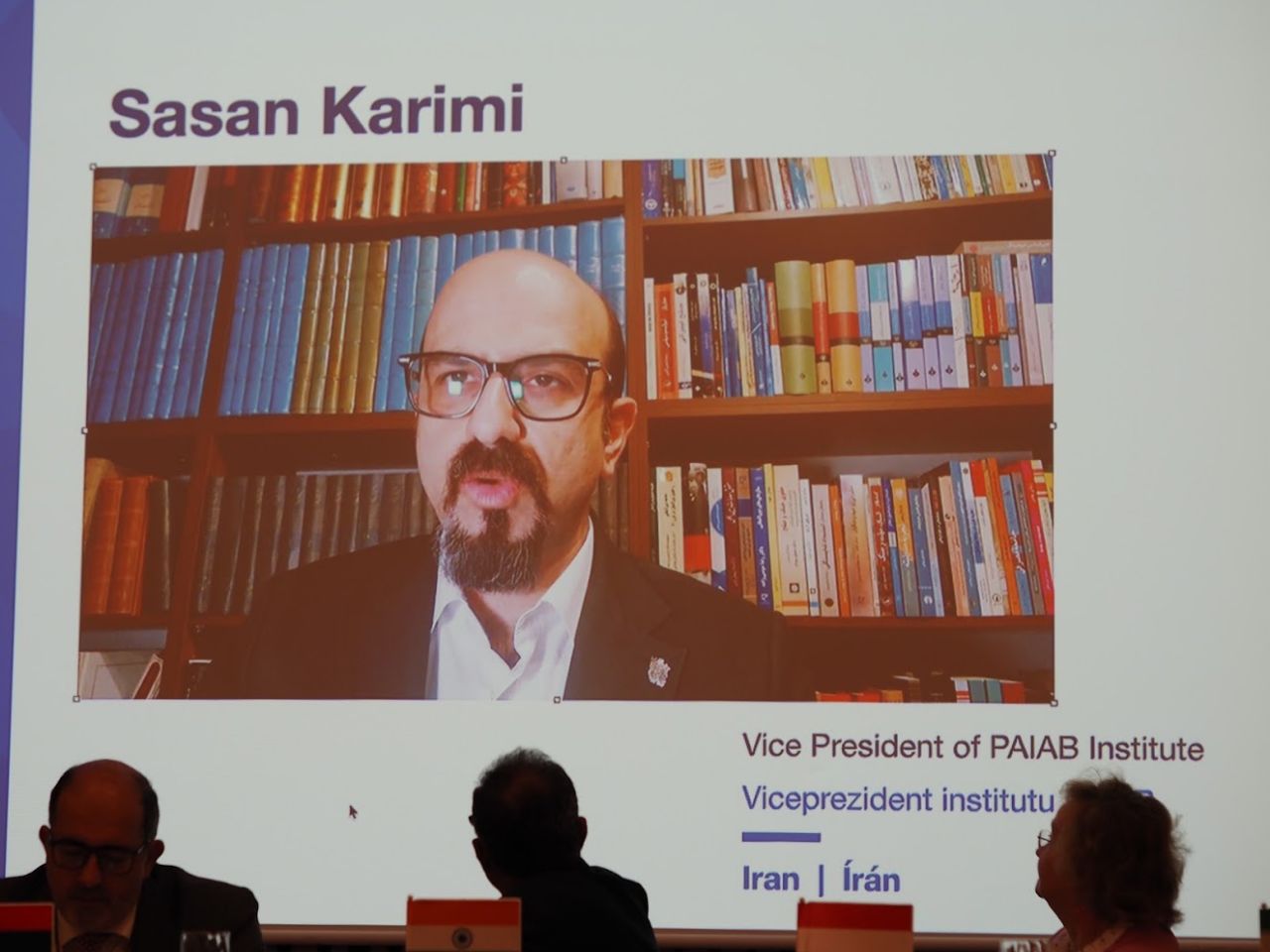
Distinguished colleagues,
Ladies and gentlemen,
It is a pleasure to participate in this discussion on Central Europe, BRICS and the Global South.
Let me begin with a proposition: we may already be living in a post-polar world.
This does not mean a world without great powers or competition. It means that power and influence are increasingly distributed among states, institutions, technology companies, financial networks and transnational actors, across multiple geographical and functional spaces. We should therefore be cautious about interpreting every crisis as evidence of a new bipolar or multipolar order.
But what is the position of Iran in a post polar order?
For decades, Iran has been approached primarily through a security lens, particularly through its nuclear program. Yet we should distinguish between an actual security problem and a process of securitization. We have an experience: the JCPOA demonstrated that a highly sensitive issue could be placed within a multilateral, legally structured and technically verified framework.
More broadly, Iran has demonstrated considerable continuity and resilience as a state. Military pressure and sanctions have not eliminated Iran as a regional actor. Iran therefore remains a persistent element of the regional balance.
This matters for Europe.
If the international system is becoming post-polar, Europe cannot approach the Middle East exclusively through the strategic vocabulary of another power. Europe retains significant normative power through diplomacy, law, institutions, multilateralism and standard-setting.
This is where Central Europe and the Global South become particularly relevant.
Central Europe has experienced profound geopolitical transformation and therefore understands the importance of diversification. The Global South, meanwhile, is not a single bloc, but its growing economic and political agency is changing the international system.
BRICS is one expression of this transformation. It should not be understood as an anti-Western alliance. Its significance increasingly lies in the demand of emerging powers for greater agency in global governance, finance and development.
The chance is: Europe does not have to choose between the United States and the Global South. It can maintain relationships with different centers of power and diversify its partners, markets and diplomatic relationships.
Iran could potentially be one such partner. Energy, transport, connectivity, technology, industry, infrastructure, higher education and scientific cooperation all offer areas for engagement.
The deeper issue is European strategic agency.
The experience of the JCPOA showed that diplomacy can transform a seemingly intractable security issue into a negotiated and monitored framework. It also demonstrated that transatlantic partnership does not necessarily require the disappearance of European autonomy.
Europe's historical contribution can therefore be more ambitious. It can act as a bridge between different centers of power rather than an extension of any single one.
Central Europe brings its experience of geopolitical transformation. BRICS represents part of the emerging agency of the Global South. Europe brings institutional and normative capacities. Countries such as Iran can connect different regional and civilizational spaces.
This is not about replacing one hegemon with another. It is about creating an international environment in which hegemony becomes less necessary.
So the fundamental question is not simply: Who will become the next pole?
It is: Do we really need another pole?
Perhaps Europe, Central Europe and the Global South can demonstrate that international cooperation does not require permanent geopolitical camps.
That would be a genuinely European contribution to a post-polar world.
Thank you very much.
File