Essay on Shargh Newspaper - June 9, 2019 -
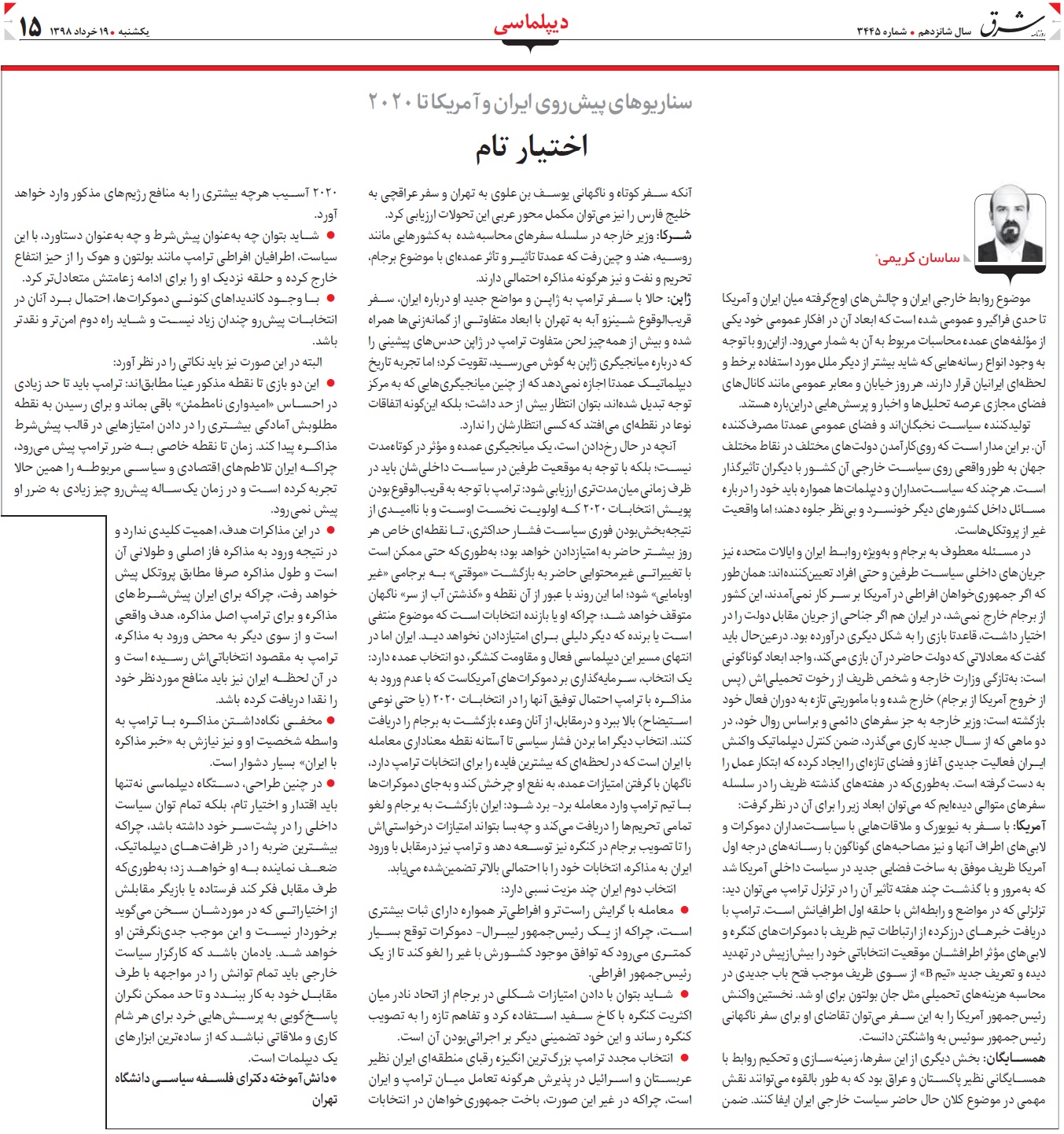
The original text is in Persian and the following translation was done by Ai.
The issue of Iran's foreign relations and the escalating challenges between Iran and the United States has become so widespread and public that its dimensions in public opinion are considered one of the major components of the calculations related to it. Therefore, and given the existence of various media that are perhaps more used online and in real time by Iranians than by other nations, every day the streets and public passages, like cyberspace channels, are the arena of analysis, news, and questions in this regard.
The elites are the producers of policy, and the public space is mainly its consumer. It is based on the fact that the coming to power of different governments in different parts of the world actually affects the foreign policy of that country with others. Although politicians and diplomats must always appear cool and indifferent to the internal issues of other countries, the reality is different from the protocols.
In the issue of the JCPOA, and especially the relations between Iran and the United States, the internal political currents of the parties and even individuals are decisive: just as if the radical Republicans had not come to power in the United States, the country would not have withdrawn from the JCPOA, in Iran, if a government from the opposite current had taken power, it would have certainly changed the game. At the same time, it should be said that the equations in which the current government is playing have various dimensions: Recently, the Foreign Ministry and Zarif himself have emerged from their imposed lethargy (after the US withdrawal from the JCPOA) and have returned to their active period with a new mission: In addition to constant trips and according to his routine, in the two months since the new working year, the Foreign Minister has started new activities while diplomatically controlling Iran's reaction and creating a new atmosphere that has taken the initiative. In the past few weeks, we have seen Zarif on a series of consecutive trips, for which the following dimensions can be considered:
America: By traveling to New York and meeting with Democratic politicians and their surrounding lobbies, as well as various interviews with top-tier American media, Zarif succeeded in creating a new atmosphere in American domestic politics, which over time and over the course of a few weeks can be seen in Trump's wavering: a wavering in both his positions and his relationship with his inner circle. Upon receiving leaked news about Zarif's team's connections with Congressional Democrats and their influential lobbies, Trump saw his electoral position as more threatened than ever, and Zarif's new definition of "Team B" opened a new chapter in calculating the costs imposed on him, such as John Bolton's case; the US president's first reaction to this trip can be considered his request for a sudden visit by the Swiss president to Washington.
Neighbors: Another part of these trips was to lay the groundwork and strengthen relations with neighbors such as Pakistan and Iraq, which could potentially play an important role in the current macro issue of Iranian foreign policy. In addition, Yusuf bin Alawi’s brief and sudden trip to Tehran and Araqchi’s trip to the Persian Gulf can also be assessed as complementing the Arab axis of these developments.
Partners: The Foreign Minister also went on a series of calculated trips to countries such as Russia, India, and China, which mainly have a major impact on the issue of the JCPOA, sanctions, and oil, as well as any possible negotiations.
Japan: Now, with Trump’s trip to Japan and his new positions on Iran, Shinzo Abe’s upcoming trip to Tehran has been accompanied by different dimensions of speculation, and above all, Trump’s different tone in Japan has reinforced previous speculations about Japanese mediation. However, the experience of diplomatic history generally does not allow us to expect too much from such mediations that have become the center of attention; Rather, such events typically occur at a point where no one expects them.
What is happening is not a major and effective mediation in the short term, but rather should be assessed in a more medium-term context, given the situation of the parties in their domestic politics: Trump, given the imminent 2020 election campaign, which is his top priority, and with his disappointment in the immediate results of the maximum pressure policy, will be more and more willing to make concessions up to a certain point, so much so that he may even be willing to return “temporarily” to a “non-Obama” agreement with non-substantive changes, but this process will suddenly stop when he passes that point and “gets out of his head.” Because he is either the loser of the election, which is out of the question, or the winner, who will no longer see any reason to make concessions.
However, Iran has two major choices at the end of this path of active diplomacy and active resistance: One choice is to invest in American Democrats, who, by not entering into negotiations with Trump, will increase their chances of success in the 2020 elections (or even some kind of impeachment) and in return, receive from them a promise to return to the JCPOA.
The other choice is to bring political pressure to the brink of a meaningful deal with Iran, which at the moment when it is most beneficial for Trump's election, will suddenly turn in his favor by gaining major concessions and enter into a win-win deal with the Trump team instead of the Democrats: Iran will receive a return to the JCPOA and the lifting of all sanctions, and may be able to extend its requested concessions until the JCPOA is ratified by Congress, and Trump, in turn, will find his election guaranteed with a higher probability by Iran entering into negotiations.
Iran’s second choice has several relative advantages:
A deal with a more right-wing and extremist orientation is always more stable, because a liberal-Democrat president is much less likely to cancel his country’s existing agreement with another than an extremist president.
Perhaps by making formal concessions in the JCPOA, it is possible to take advantage of the rare alliance between the majority of Congress and the White House and get the new understanding approved by Congress, which is another guarantee of its enforceability.
Trump’s re-election is the biggest incentive for Iran’s regional rivals, such as Saudi Arabia and Israel, to accept any interaction between Trump and Iran. Otherwise, a Republican defeat in the 2020 election would cause even greater damage to the interests of the aforementioned regimes.
Perhaps, either as a precondition or as an achievement, this policy could remove Trump’s extremist entourage, such as Bolton and Hook, from the field of benefit and make his inner circle more balanced for the continuation of his rule.
Despite the current Democratic candidates, the chances of them winning the upcoming elections are not very high, and perhaps the second path is safer and more critical.
Of course, in this case, some points should also be taken into account:
These two games are exactly the same up to this point: Trump must remain largely in a state of "uncertain hope" and be more prepared to make concessions as preconditions for negotiations in order to reach his desired point. Time will go against Trump up to a certain point, because Iran has already experienced the relevant economic and political turbulence, and not much will go against him in the coming year.
In these negotiations, the goal is not of key importance, and as a result, entering into negotiations is the main and long phase, and the length of the negotiations will proceed solely according to protocol. Because for Iran, the preconditions for negotiations and for Trump, the principle of negotiations are the real goal, and on the other hand, as soon as he enters into negotiations, Trump has achieved his electoral goal, and at that moment Iran should have received its desired benefits in cash.
Keeping negotiations with Trump secret is very difficult due to his personality and his need for "news of negotiations with Iran." In such a design, the diplomatic apparatus must not only have full authority and discretion, but also the full power of domestic politics behind it. Because the greatest blow in diplomatic subtleties will be inflicted on him by the weakness of the representative; so that the other party thinks that the envoy or actor in front of him does not have the authority he talks about, and this will cause him not to be taken seriously. It should be remembered that the foreign policy agent must use all his strength in confronting his other party and, as much as possible, not worry about answering trivial questions for every business dinner and meeting, which are among the simplest tools of a diplomat.
Shargh Daily link

File