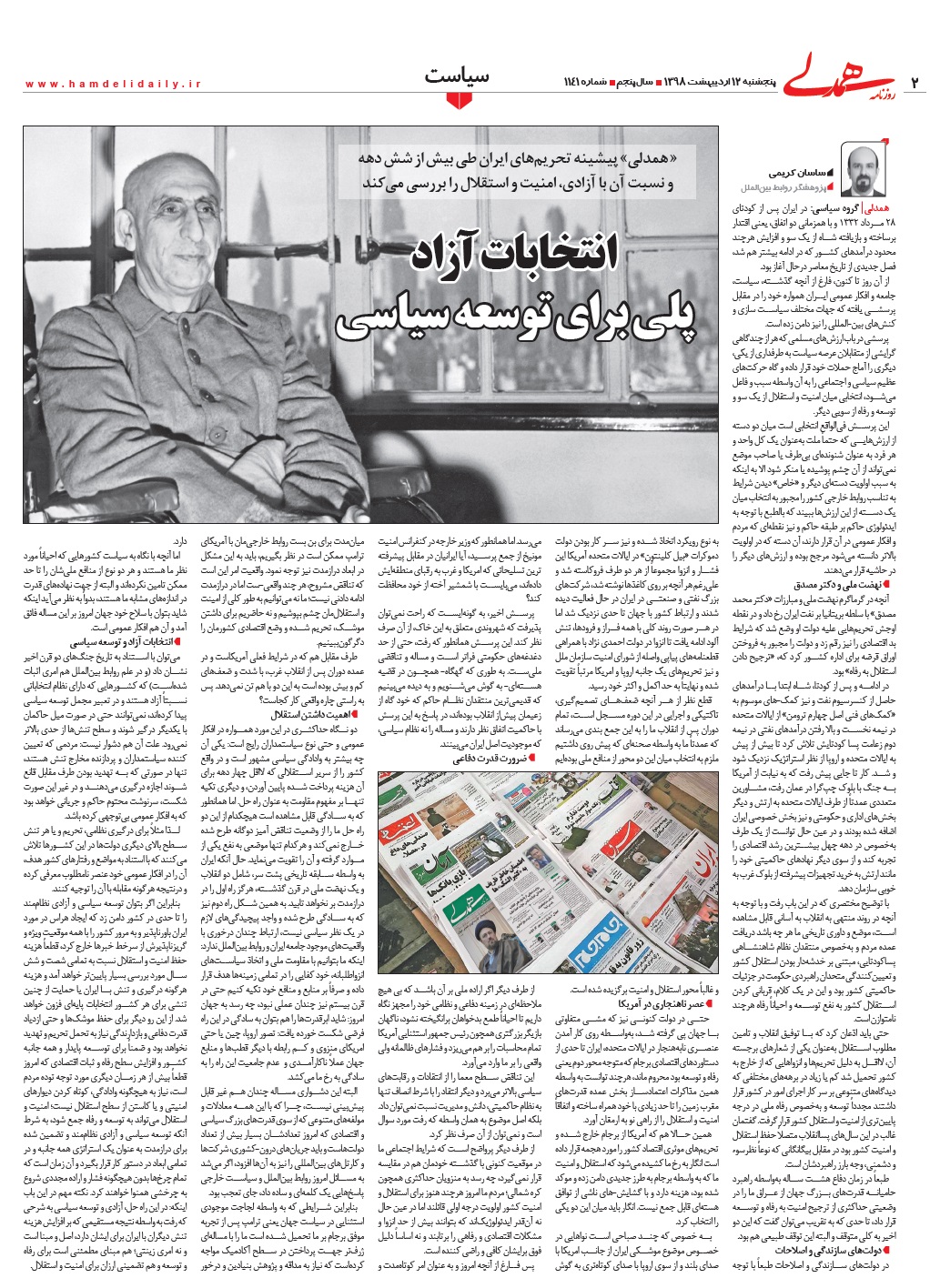
Essay on Hamdeli Newspaper - May 2, 2019 -
The original text was in Persian and the following translation was done by Ai.
In Iran, after the coup of 18 Mordad 1332 (1953) and with the coincidence of two events, namely the Shah's regained authority on the one hand and the limited increase in the country's income, which continued to increase, a new chapter in the contemporary history of the country had begun. From that day until now, regardless of what has happened, Iranian politics, society and public opinion have always found themselves facing a question that has fueled various aspects of policymaking and international actions.
A question about certain values that from time to time makes a tendency of opposing sides in the political arena to favor one over the other the target of their attacks and sometimes causes and subjects great political and social movements through that intermediary: a choice between security and independence on the one hand and development and prosperity on the other.
This question is actually a choice between two sets of values that the nation as a whole and each individual as a neutral listener or a position holder cannot ignore or deny, unless due to the priority of other hands and "special" views of the conditions in accordance with the country's foreign relations, they are forced to choose between one set of these values. Naturally, considering the ideology of the ruling class and the point where the people and public opinion are, the set that is considered to be in higher priority is preferred and the other values are marginalized.
What happened in the heat of the national movement and Dr. Mossadegh's struggles with British domination of Iranian oil, and at its peak, the sanctions imposed on his government, which also created bad economic conditions and forced the government to sell bonds to run the country, was the preference for independence over prosperity.
In the aftermath of the coup, the Shah initially tried to get closer to the United States and Europe strategically, using the revenues from the oil consortium and the so-called "Truman Fourth Principle" technical assistance from the United States in the first half of his post-coup rule, and the increase in oil revenues in the second half of his post-coup rule. Things went so far that he went to war with the leftist bloc in Oman on behalf of the United States. Numerous advisors, mainly from the United States, were added to the army and other administrative and governmental sectors, as well as the private sector of Iran. At the same time, he was able to experience the greatest economic growth, especially in the 1940s, and on the other hand, he was able to organize his governing institutions, such as the army, well by purchasing advanced equipment from the Western bloc.
With the brief explanation given in this regard and considering what is easily observable in the process leading up to the revolution, whatever our historical position and judgment, the majority of the people, and especially the critics of the post-coup imperial system, perceived the country’s independence as being undermined and the government’s strategic allies determining the details of the country’s governance, and this, in a word, was sacrificing the country’s independence in favor of development and possibly welfare, albeit unbalanced. It must even be acknowledged that with the success of the revolution and the desired provision of independence as one of its prominent slogans, at least due to the sanctions and isolation imposed on the country from abroad, development and especially national welfare were again placed at a lower level than the country’s security and independence at different times when there were diverse perspectives on the implementation of affairs in the country. The dominant discourse in these post-revolutionary years was consistently about preserving the country’s independence and security against foreigners whose typical negative views and hostility are a prominent feature of their strategy. Naturally, during the eight-year defense of Iraq, due to the supportive strategy of the world's great powers, we were placed in a maximum state of preference for security over prosperity and development, to the extent that it can be said that the latter two stopped altogether, and of course this stop was natural.
In the governments of construction and reform, naturally, given the type of approach adopted and also the fact that the Democratic government of Bill Clinton was in office in the United States of America, this pressure and isolation were reduced on both sides. Despite everything that was written on paper, large oil and industrial companies were seen operating in Iran and the country's relationship with the world became somewhat closer. However, in any case, the overall process continued to be tense with all its ups and downs until the isolation in the Ahmadinejad government was constantly strengthened, accompanied by successive resolutions from the UN Security Council and unilateral sanctions from Europe and the United States, and finally reached its full and maximum extent.
Regardless of the weaknesses in decision-making, tactics, and execution during this period, the entire post-revolutionary era leads us to conclude that we have been forced to choose between these two axes of national interest due to the scene we were facing, and the axis of independence and security has often been chosen.
Even in the current government, which has pursued a different approach from the world, due to the rise to power of an abnormal element in the United States, Iran has been deprived to some extent of the economic achievements of the JCPOA, which were aimed at the second axis, namely prosperity and development, although it was able to bring the majority of Western powers with it to a large extent through these confidence-building negotiations, and incidentally, it brought security and independence in a new way.
Even now, when the United States has withdrawn from the JCPOA and has imposed effective sanctions on the country's economy, it seems to be being exposed to us that our independence and security, which were fueled and emphasized in a new way by the JCPOA, have a cost and cannot be reconciled with the openings resulting from the nuclear agreement. It seems like you have to choose between the two.
Especially since for a few days now, there have been loud voices from the United States and a more subdued voice from Europe regarding the issue of Iran's missiles. But as the Foreign Minister asked the audience at the Munich Security Conference, should Iranians protect themselves with a sword against the most advanced weapons that the United States and the West have given to their regional rivals?
The latter question is such that it is not easy to accept that a citizen of this land would give it up. This question, as it turned out, even goes beyond the concerns of the government and is a national issue and contradiction. So that occasionally - as in the nuclear issue - we hear and see that the oldest critics of the ruling system, who themselves were sometimes leaders before the revolution, agree with the government in answering this question and see the problem not as the political system, but as the essence of Iran.
On the other hand, if the national will is to keep ourselves equipped in the field of defense and military without any consideration so that the greed of the ill-wishers is not aroused, suddenly a bigger actor like the exceptional president of the United States upsets all calculations and puts cruel but real pressures on us.
This contradiction raises the level of the puzzle above political criticism and competition, and criticism can no longer be attributed with fairness only to the system of governance, knowledge and management. Rather, the essence of the matter is questioned by the same means as before and cannot be ignored.
On the other hand, it is clear that our social conditions in the current situation are not comparable to our own past, let alone to the most isolated countries like North Korea; although our people today still give top priority to the independence and security of the country, at the same time they are not ideological enough to be able to withstand excessive isolation and economic and welfare problems, nor is the above reason sufficient and satisfactory for them.
So, regardless of what we may consider today as a short-term and medium-term issue for the impasse in our foreign relations with Trump's America, we must also pay attention to this problem in the long term. The reality is that the described contradiction, although real, is not sustainable in the long term: we can neither completely give up our security and independence, nor are we willing to see our country's economic situation changed in order to have missiles.
The other side, which is the United States in its current situation and has been in the West for most of the post-revolutionary period, with varying degrees of intensity and weakness, does not accept these two together. So where is the real solution?
Two extreme views on this issue are always prevalent in public opinion and even among politicians: one is more famous for political commitment and in fact brings the country down from the bed of independence for which at least four decades have been paid, and the other relies solely on the concept of resistance as a solution. But as can be easily seen, neither of these two solutions will get us out of the dual contradictory situation proposed, and each will only take a position in favor of one of the cases and strengthen it. Meanwhile, Iran, due to its historical background, including two revolutions and a national movement in the last century, will never be able to withstand the first path in the long run. Similarly, the second path, which is simply proposed and does not have the necessary complexities in a political opinion, does not have much relevance to the existing realities of Iranian society and international relations: that we can target self-sufficiency in all fields through national resistance and the adoption of isolationist policies and rely solely on our own resources and interests was not very practical even in the twentieth century, let alone in today's world: perhaps the superpowers can also be easily found to have failed in this hypothetical path: the idea of Europe, China, or even America isolated and with little connection to other poles and resources of the world practically reveals the inefficiency and lack of comprehensiveness of this path to us.
Of course, this difficulty of the issue is not so unpredictable, because with all these equations and various components created by the great political and economic powers, which today far outnumber the number of governments, and to which should be added intra-national flows, companies, and international cartels, it would be surprising if one could give simple, one-word answers to today's issues of international relations and foreign policy.
Therefore, the conditions imposed on us by the stubbornness of an exceptional entity in world politics - namely Trump - after the successful experience of the JCPOA have confronted us with a deeper issue to address at the academic level that requires fundamental and appropriate scrutiny and research.
However, what seems at first glance, when looking at the policies of countries that are perhaps of interest to us and have secured both types of their national interests to the extent possible, and of course, are of similar sizes to ours in terms of power inputs, is that perhaps this issue can be overcome with the weapon of today's world, and that is public opinion.
It can be shown by citing the history of wars of the last two centuries (and this has also been proven in the science of international relations) that countries that have relatively free electoral systems and have, in a broad sense, achieved political development cannot engage in conflict with each other, even if the rulers so desire, and the level of tensions does not rise above a certain level.
The reason for this is not difficult: the people who determine the politicians and process the costs of the conflict will only allow conflict if they are convinced that the other side is a threat, otherwise defeat will be the inevitable fate of the ruling party and the trend that has ignored public opinion.
Therefore, for example, for military conflict, sanctions, or any other high-level conflict, governments in these countries try to introduce it as an undesirable element in their public opinion by citing the positions and behaviors of the target country and, as a result, justify any confrontation with it.
Therefore, if political development and systematic freedom can be fostered in the country to the extent that creating fear about Iran is unbelievable and gradually removing the country, with all its special and inescapable situation, from the headlines, the cost of maintaining security and independence will certainly be much lower than in the entire sixty-six years under review, and the cost of any conflict and tension with Iran or supporting such tension for any electoral-based country will increase. Therefore, there will be no need to tolerate sanctions and threats to maintain missiles and even increase defense and deterrence power. In addition, for the sustainable and comprehensive development of the country and increase the level of prosperity and economic stability, which is certainly of more concern to the masses of the people today than ever before, there is no need for any compromise, shortening of security walls, or reducing the level of independence: Security and independence can be combined with development and prosperity, provided that political development and systematic and guaranteed freedom for the long term are put on the agenda as a comprehensive strategy in all dimensions, and that is when all the wheels will start to turn in harmony without any pressure or renewed will. The important point in this regard is that: in this solution, political freedom and development, as explained above, are the principle and basis, not an ornament, due to the direct result that they have on increasing the cost of tension between others and Iran for them; they are both a reliable basis for prosperity and development and a cheap guarantee for security and independence.
File