Essay on PAIAB website August 1, 2026 -
The original text is in Persian and the following translation was done by Ai.
Abstract
National interests, in the traditional view, are often limited to the material interests of the nation-state. In this understanding, national interests are placed on a spectrum that includes territorial security and the preservation of territorial integrity on one side, and economic growth, prosperity, and the international status of countries on the other. However, profound changes in the world system and new research show that such a perception no longer responds to the complexities of today's world and requires a fundamental revision. The etymology of the word interest also confirms this conceptual transformation; rather than simply referring to "interest" in the material sense, this word refers to the interests, tendencies, and priorities that are of fundamental importance to a nation and distinguish it from other nations. From this perspective, national interests are not simply a set of material desires, but a set of values, priorities, and interests that shape and stabilize the existence, identity, and position of a country in the global system. Accordingly, this report, relying on fundamental changes in the concept of benefit and security, as well as the emergence of global networks of value and capital, attempts to present a dynamic, multi-layered, and strategic definition of national interests.
Statement of the Problem
The reason why, despite all this repetition and despite the old use of this concept in the literature of political science, why is there still an effort to define it, is above all because, despite the above, it seems that defining national interests and its relationship to national security, etc., is first of all difficult and this concept, although frequently repeated, is largely undefined and unagreed upon, and to the extent that it is referred to, there is no agreement on its meaning. Second, it must be acknowledged that the definition, scope, and proportion of the concept of national interest change over time and in response to changing realities. Therefore, even past studies on the subject may be of limited use today and may not be used accurately.
Etymological and Conceptual Analysis: Beyond Pure Profit
The word “interest” or “benefit” comes from the Latin root interesse, meaning “to be between” or “to make a difference.” If we were to go back to the root of this word, we could emphasize that national interest can refer to matters that distinguish a nation from other nations and determine its strategic and vital priorities. From this perspective, national interest cannot be reduced to mere economic or material gain; rather, this concept concerns who, why, and how a nation is present in the global arena.
Therefore, perhaps the term national interests would be more appropriate as opposed to the term national desires or aspirations, but given the prevalence of the term national interests in Persian, a new definition can be provided. The new definition of national interests is a set of existential goals, identity values, strategic priorities, and vital interests and benefits that enable the continuity of collective life, socio-economic prosperity, and the status and prestige of a nation in the interconnected global system and distinguish it from other nations.
Paradigm Shift: From Fixed and Territorial Interests to Dynamic and Networked Interests
One of the major drawbacks of previous definitions of national interests was the static, purely territorial and material view of national interests. The study underlying this report, by introducing the transformation of the concept of security at four levels (from physical survival to happiness) and also emphasizing “interconnected security”, shows that national interests have not been left out of this transformation. Today, national interests cannot be defined within closed borders; rather, this definition is strongly influenced by three new components:
Global Value Chains (GVC): The presence or absence of a country in these chains directly determines the rate of growth, employment, technology and even the security of a country. In other words, “joining the value chain” has become a vital and existential benefit in itself and can also be a security-creating benefit for a country.
Global capital: Financial flows and capital that operate beyond national governments are one of the main pillars of power and financing development. Given that the provision and accumulation of capital is the main condition for achieving economic development, deprivation of this network will mean deprivation of one of the fundamental foundations of national interests.
Interconnected security networks: In today's world, the security of a country is not separate from the security of the region and the world. Today, security has also become a global phenomenon and the security of international actors is interconnected in such a way that it can be said that the security of all actors has become interdependent and the main security threats are global and beyond the national borders of countries. Therefore, "participatory security" and "reducing tension through economic convergence" are defined as a macro strategy for realizing national interests and security.
Levels of National Interest in the New World Order
Using the concepts of "human security" and "happiness," national interests can be defined at four interconnected levels that interact and evolve with each other:
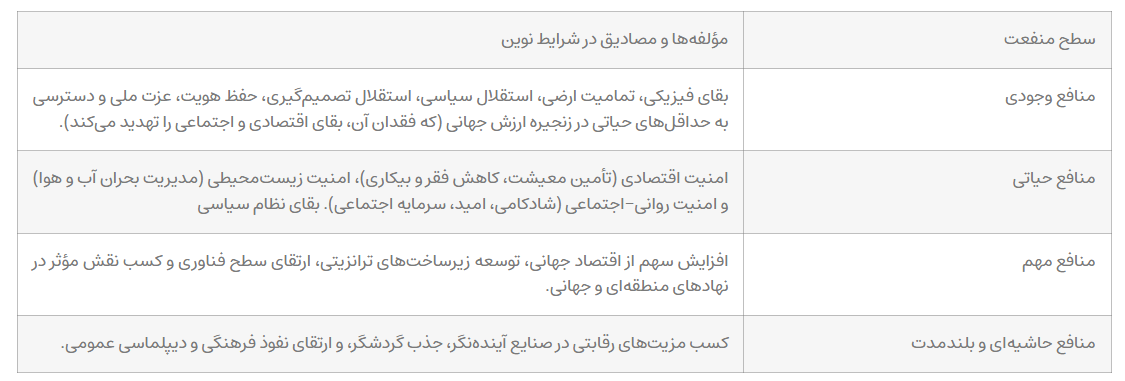
The key point in this new classification is that “joining global networks” is no longer a secondary strategic choice, but is directly at the level of existential and vital interests; because economic isolation will lead to political insecurity, environmental crisis, and the collapse of social capital.
National interests and national security; a two-way and complementary relationship
In the traditional paradigm, national security was often defined as the guardian of the border and the protector of national interests. However, by elevating the concept of security to “happiness” and “peace of mind,” it can be shown that, first, national security is a necessary condition for the realization of national interests, but it is not a sufficient condition. Furthermore, the realization of comprehensive interests (welfare, justice, development, mental health, legitimate freedoms) itself leads to the strengthening of national security; because real security is formed in a society where people enjoy a decent quality of life, and ultimately, it must be believed that security cannot be realized alone and outside of global networks.
To put it more clearly, security and development within the framework of national interests are two sides of the same coin. Economic development and linkages to value chains are no longer a welfare goal, but a security imperative, and security, without a development context, becomes hollow and meaningless protection. In fact, isolationist security will eliminate security in its true sense, that is, human security.
Strategic Requirements for Iran; Reconsidering Priorities
In short, it can be said that in the current historical period, Iran’s fundamental problems in realizing its national interests include its withdrawal or exclusion from global value chains, financial isolation and limited access to global capital and technology, being at the center of security crises and draining the negative energy of the international system, lack of an established position in the regional order, and an inappropriate image among public opinion and major actors in the global system. In this framework, new priorities for securing Iran’s national interests should be redefined based on the following principles:
Replacing “negative security” with “security through regional integration”: cooperating with neighbors to shape a new security order, not in opposition to the world, but as a bridge to connect to global networks. At the same time, maintaining the necessary and traditional capabilities for maintaining security is essential;
Setting a quantitative and clear goal for entering the global economy: for example, returning Iran’s share of the global economy to more than one percent through targeted joining value chains in the fields of energy, petrochemicals, mining, and agriculture;
Creating the role of a “strategic link” between East and West: utilizing Iran’s transit and corridor position as an active strategy to gain economic and security benefits, not just a geographical proposition;
Prioritizing interests based on existential threats and focusing on eliminating environmental (drought, environmental pollution) and economic (inflation, unemployment, and economic decline) threats as direct threats to national security and citizens’ happiness;
A new understanding of power: Power in the current system is not only military, but also includes power in networks of capital, technology, information, and public diplomacy. Any neglect of these dimensions means falling behind national interests;
An effort to create a new image of Iran as a manifestation of rational Shiism that seeks to play a role as a global link and build a new world based on rationality and harmony.
Summary and Conclusion
The definition of national interests in the 21st century no longer fits within the framework of closed borders and purely territorial priorities. According to the theoretical framework governing the ruling report, “national interests” are the dynamic coordination between survival, development, identity, and position in a system whose fate is tied to global networks of value, capital, and security.
For Iran, this means moving from a defensive and passive view of “interests” to a smart and proactive strategy in which, first, security is secured through development and integration, not simply through military deterrence, although military capabilities need to be maintained. Second, economic interests are defined through joining global networks, not through an isolated economy. It should be noted that the resistance economy (which, in the words of the martyred leader, will be “endogenous, progressive, and extroverted”) has been formed in response to global impulses and can be realized within global networks, and ultimately, cultural and national identity can be transformed into diplomatic advantage through constructive and effective interaction.
The present report, by emphasizing concepts such as “happiness,” “interconnected security,” and “value chain,” attempts to open a new window towards a fundamental redefinition of national interests and free policymaking from the trap of old stereotypes and sterile categories.
PAIAB Link

File