Essay on Shargh Newspaper, August 16, 2026 -
The original text is in Persian and the following translation was done by Ai.
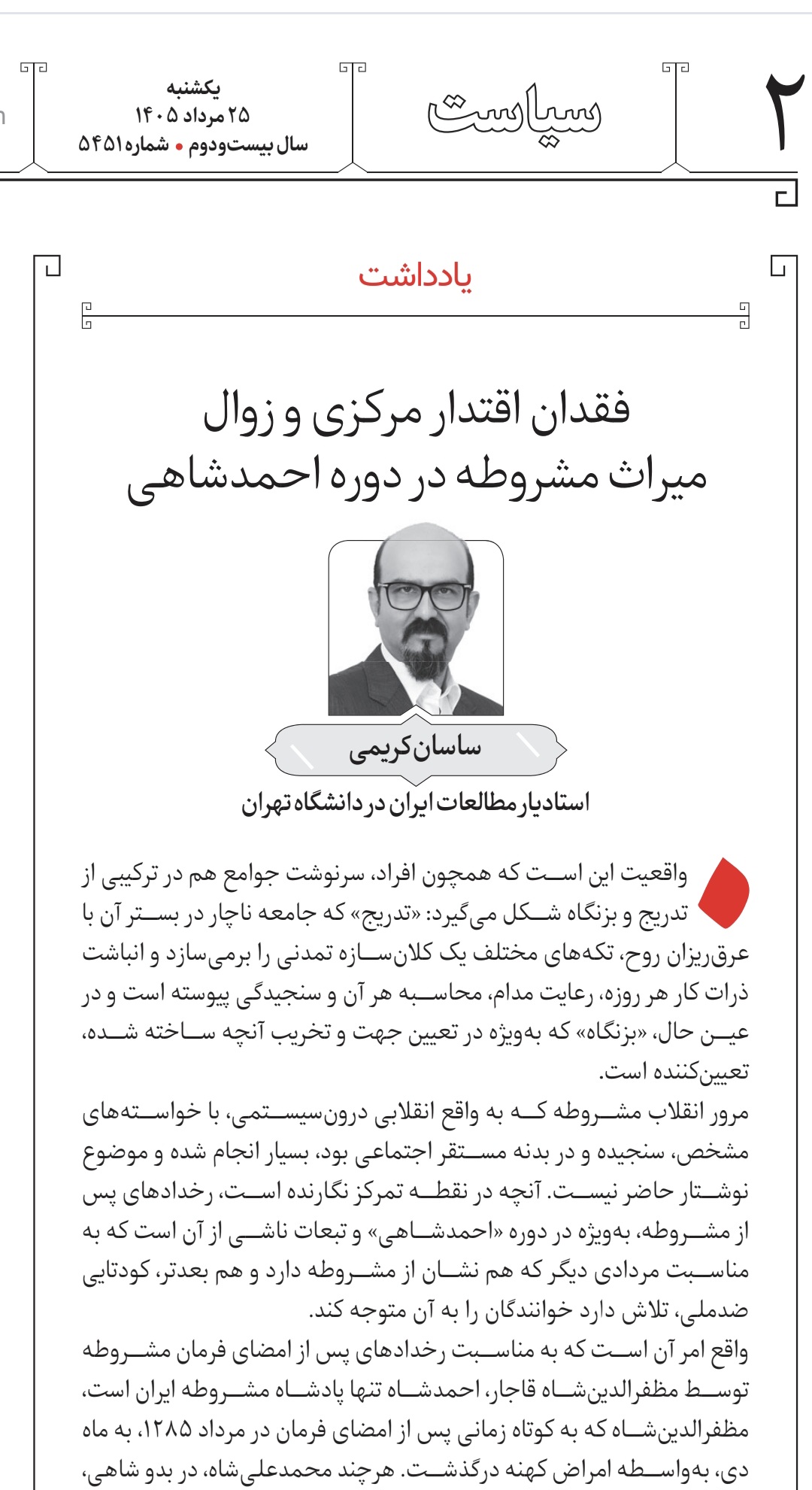
The reality is that, like individuals, the fate of societies is shaped by a combination of gradualism and apocalypse: "gradualism" in which society inevitably builds various pieces of a civilizational macrostructure with the sweat of its soul, and the accumulation of particles of daily work, continuous observance, calculation of each moment, and continuous seriousness, and at the same time, "apocalypse" that is especially decisive in determining the direction and destruction of what has been built.
The review of the Constitutional Revolution, which was actually an intra-system revolution, with specific, measured demands, and within an established social body, has been done a lot and is not the subject of the present article. What the author focuses on are the events after the Constitutional Revolution, especially during the "Ahmad Shahi" period, and the consequences that arise from it, which he tries to make readers aware of on the occasion of another August that both symbolizes the Constitutional Revolution and, later, an anti-national coup.
The fact is that, in the context of the events following the signing of the Constitutional Decree by Mozaffar al-Din Shah Qajar, Ahmad Shah is the only constitutional monarch of Iran, Mozaffar al-Din Shah who died of old diseases shortly after the signing of the decree in Mordad 1285, in the month of Dey. Although Mohammad Ali Shah, at the beginning of his reign, had no other choice and spent the least effort to tolerate the Majles, at least apparently through the failed assassination, he showed a different nature and put what we know in opposition to the constitutional principle and the Majles in the most brutal way and also imbued with dependence on the stage and with the end of the petty tyranny in the hands of the conquerors of Tehran, including Azari, Gil and Bakhtiar, he handed over the throne to a crying child.
In addition to the above, it is less likely that even the most insistent supporters of Pahlavi would consider this period as a period characterized by a minimum of constitutional content; Or perhaps the first 12 years of the second period, which we will mention later.
So what remains is the previous claim that: "The only truly constitutional king of Iran was Ahmad Shah Qajar." Considering that the phenomena of history are all gray, it must be admitted that this only constitutional king was, above all, a child, fat, and then sick and absent. The emergence of such a new king, which was partly due to the constitutional system and partly due to the child's heartbreak from separation from his family and finally Ahmad Shah's own temperament, initially caused joy and expansion of the minds of intellectuals and politicians, and reliance on the old Qajar men brought about a dilemma in terms of the course of affairs for them and, of course, the type of citizens.
But the reality of history, which coincided with the First World War, the reoccupation of the country by Britain and Russia, the Bolshevik revolution in the northern neighbor, the failed presence at the Paris Peace Conference, and the 1919 treaty, all laid the groundwork for the social demand for central authority. So that Britain's desire for a more prominent role in Iran following the changes in Petersburg and Moscow, in this context of the Iranian mind, which was now fed up with the uncertainty of the state system, paved the way for the Esfand 1299 coup. It is said that when the coup was imminent, the Qajar Shah was fearfully looking for a way to transfer his large amount of silver coins to Baghdad and then to Bombay until he was relieved that the coup was not against the monarchy, but against the government. Although this happened, and after Seyyed Zia and finally Reza Khan became prime ministers, the Qajar reign lasted for more than four more years, but Ahmad Shah's half-joining of the Iranian monarchy was also removed. Moving away from judgments steeped in unscientific everyday life, it should be said that the social acceptance of the Reza Khan phenomenon and his transformation into Reza Shah had at least two simultaneous causes: the lack of central authority in the country in successive years on the one hand, and the ability to resolve the issue of Reza Khan during the period of Sardar Sepahi and Prime Minister.
This same history may have fueled the perception of rumors in the minds of this land that "the country's work does not progress with softness, constitutionalism, and democracy, but rather openness requires a powerful reformer." Therefore, although the Reza Khan and Reza Shah periods brought significant constructions, one should not forget a more important matter, which was the plundering of the entire constitutional heritage by Reza Khan, for whom blood had been shed. The Shah was once again unconditionally in power, and now a Kazakh. The Shahi dynasty was gone, and the important consequence of both was that “Iran’s path now was not to emerge as a legitimate and efficient power, but rather as an efficiency at the cost of militarization and increasingly unconditional power.” Perhaps a major part of the subsequent developments in Iranian history cannot be considered independent of this collapse of the constitutional institution. It should be said that “now, not the parliament, but the idea of the constitution was truly shot to pieces”; a loss that should be attributed not only to Reza Khan, but also to the lack of central authority, which paved the way for the rise of militarism and the ever-increasing power in the face of any external phenomenon. In fact, with all that was built, what Iran lost during the first Pahlavi period was much more fundamental and fundamental, and that right path was to govern based on law, seriousness, and pluralistic convergence.
Perhaps another period in which the Shah, this time not due to physical weakness or absence from the country, but rather due to the occupation of the country, his young age, and the manner in which he ascended to the throne, was not in the main circle of power was the first 12 years of the second Pahlavi dynasty, from Shahrivar 1320 to Mordad 1332. A period in which the weakness of the Shah brought him closer to the image of a king who reigns and not a government, and reliance on the strong men of the Qajar and Pahlavi eras, such as Qavam al-Saltaneh and Dr. Mossadegh, and the openness of the political space for the educated and politically inclined were pleasing. However, the lack of central authority and the conflict between the government and the court, in parallel with the oil and foreign issues, exhausted the nation that defended Dr. Mossadegh and the national resistance movement on 30 Tir 1952 (Thursday, 1952) to the extent that the ground was prepared for the unopposed coup of 1953. Now the Shah, who had been staying in Rome in a white suit and trousers, stepped off the plane into Tehran in full military uniform and hat, and the Shah, in this attire, dealt the final blows to the remnants of the idea and system of constitutionalism. Central authority, as the word implies, is legitimate. This authority, not necessarily in the form and guise of the Shah, but in an institution conditioned by law, had to be so efficient and clear to the people that it did not prepare the ground for what followed this apparently expansive period. Iran, with all its sharpened teeth, accumulation of problems and advancement in the constitutional idea, had to move towards development in the right way. It was as if in both of the aforementioned times, the apparent development and efficiency due to militarism were unsuccessful and even damaging: just as ineffective as the period of the lack of central authority of Ahmad Shahi; now only with a slight delay.
Shargh Link

File