"Policy Report" in the PAIAB Think Tank Magazine
Magazine No.2, Autumn 1405 -
The original text is in Persian; the following translation was generated by AI.
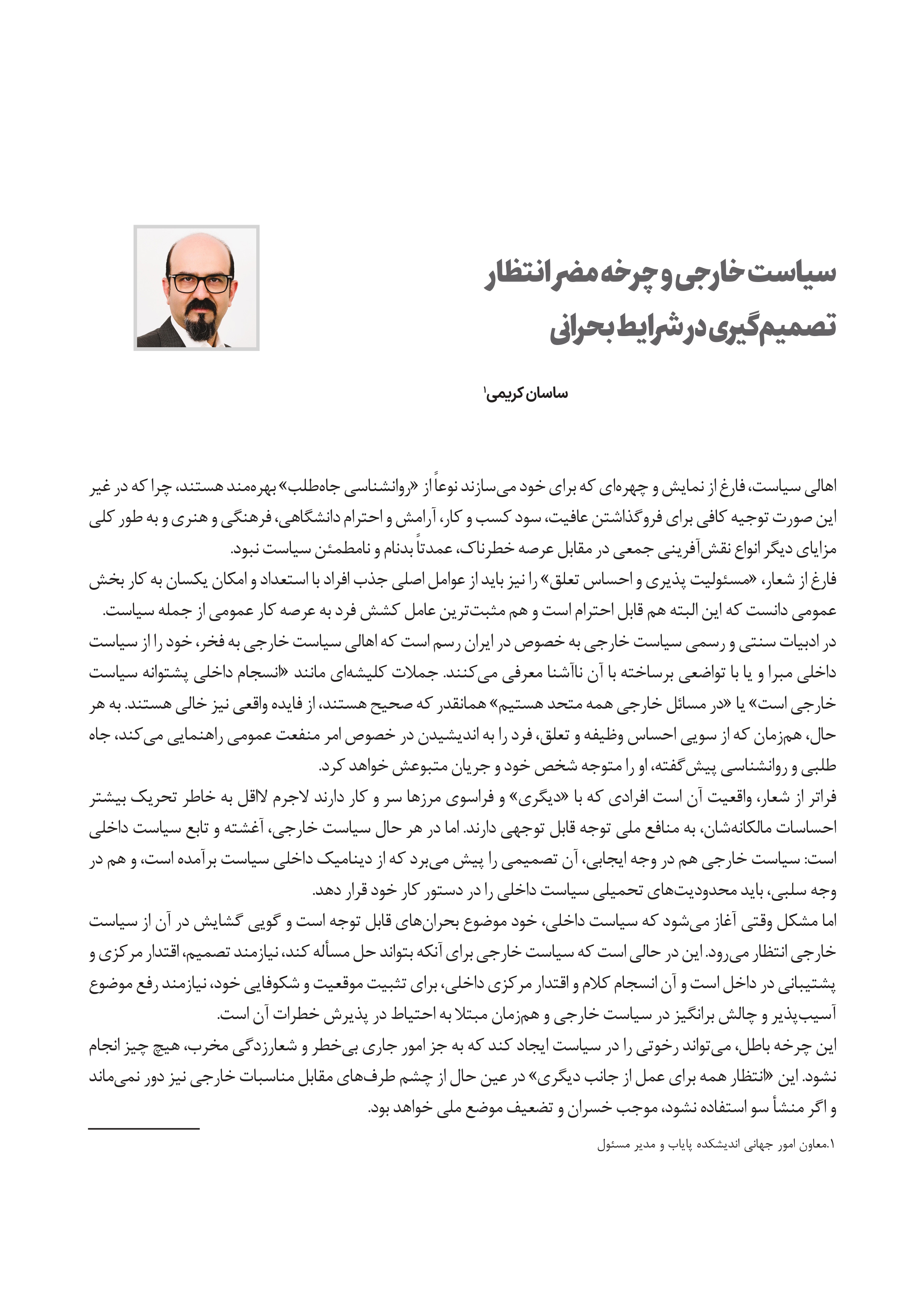
Political figures—regardless of the public image or persona they cultivate—typically possess an "ambitious psychology." Without this trait, there would be no sufficient justification for forsaking personal comfort, business profits, and the tranquility and prestige associated with academic, cultural, or artistic pursuits—or the benefits of other forms of collective engagement—in favor of the perilous, often disreputable, and uncertain arena of politics.
Setting aside rhetoric, "responsibility and a sense of belonging" must also be recognized as key factors attracting talented individuals to public service. This motivation is both admirable and the most positive force drawing people toward the public sphere, including politics.
In traditional and official foreign policy discourse—particularly in Iran—it is customary for foreign policy practitioners to proudly distance themselves from domestic politics or, with feigned humility, claim unfamiliarity with it. Clichéd statements such as "domestic cohesion underpins foreign policy" or "we stand united on foreign affairs," while factually correct, often lack real utility. Ultimately, while a sense of duty and belonging steers the individual toward considering the public interest, that aforementioned ambition and psychology simultaneously focus their attention on themselves and their affiliated political faction. Beyond mere slogans, the reality is that those who engage with "the other" and operate across borders inevitably—if only due to the heightened arousal of their sense of ownership—pay significant attention to national interests. Yet, foreign policy is inextricably linked to and subordinate to domestic politics: in its proactive aspect, it advances decisions born of domestic political dynamics; in its reactive aspect, it must contend with the constraints imposed by the domestic political landscape.
The problem arises, however, when domestic politics itself is mired in significant crises, and a breakthrough is—as it were—expected to come from the realm of foreign policy. This creates a paradox: for foreign policy to resolve issues, it requires decisive action, central authority, and domestic backing; conversely, that very domestic coherence and authority—in order to consolidate its position and flourish—requires the resolution of vulnerable or contentious foreign policy issues, even while remaining wary of the risks involved.
This vicious cycle can induce a political paralysis where nothing is accomplished beyond innocuous routine matters and destructive sloganeering. This mutual expectation—where each side waits for the other to act—does not go unnoticed by foreign counterparts; if it does not lead to outright exploitation, it inevitably results in loss and the weakening of the national position.
Such waiting is both corrosive and exasperating. Following this cycle of anticipation across domestic and foreign policy, the market, daily life, and society at large become "desperate for a resolution"—and therein lies the onset of danger. Public anticipation for the finalization of issues and political engagement may pave the way for choices that are not necessarily the best ones. Public pressure to resolve outstanding matters, combined with potential maneuvers by opposing parties, could corner a politician and force a decision.
Given the country's current situation—whereby an understanding with the United States failed to materialize for whatever reason—there is a need for authority in both decision-making and the implementation of foreign policy. The various tiers of the decision-making system and the foreign policy apparatus require decisiveness in action—much like the decision-making and execution processes seen in the military during wartime.
A sound foreign policy decision is reached only when it is grounded in expert analysis. The expert and decision-making apparatus within foreign policy will truly serve the national interest only if it frees itself from the classic and homegrown pitfalls of policymaking: avoiding entanglement in public discourse, self-constructed narratives, organizational interests, and bureaucratic lethargy or risk-aversion. This entails expert planning that—unencumbered by the personal or organizational interests and risks of the planners, and disregarding preconceptions stemming from prevailing discourses or narratives deliberately promoted in the media and public sphere—analyzes the current reality and charts a path to the desired outcome based on data, an analysis of concrete conditions, and an avoidance of mere slogans or voluntarism.
It must be noted, however, that the path to achieving the desired state and securing national interests is not always pleasant or low-cost. Just as the path to success in military confrontation entails sacrificing lives and expending a portion of the nation's resources, securing national interests in the realm of foreign policy often requires—even without a guarantee of success—staking one’s personal and factional reputation and enduring labels and scorn. Yet, such decisiveness is essential for sound statecraft; putting one’s standing on the line, risking one’s credibility, and breaking the vicious cycle of hesitation constitute the primary prerequisites of nationalism and patriotism for experts and politicians alike during times of national crisis.
Magazine File