Maritime Security Conference, Ankara, Türkiye
May 2026 -
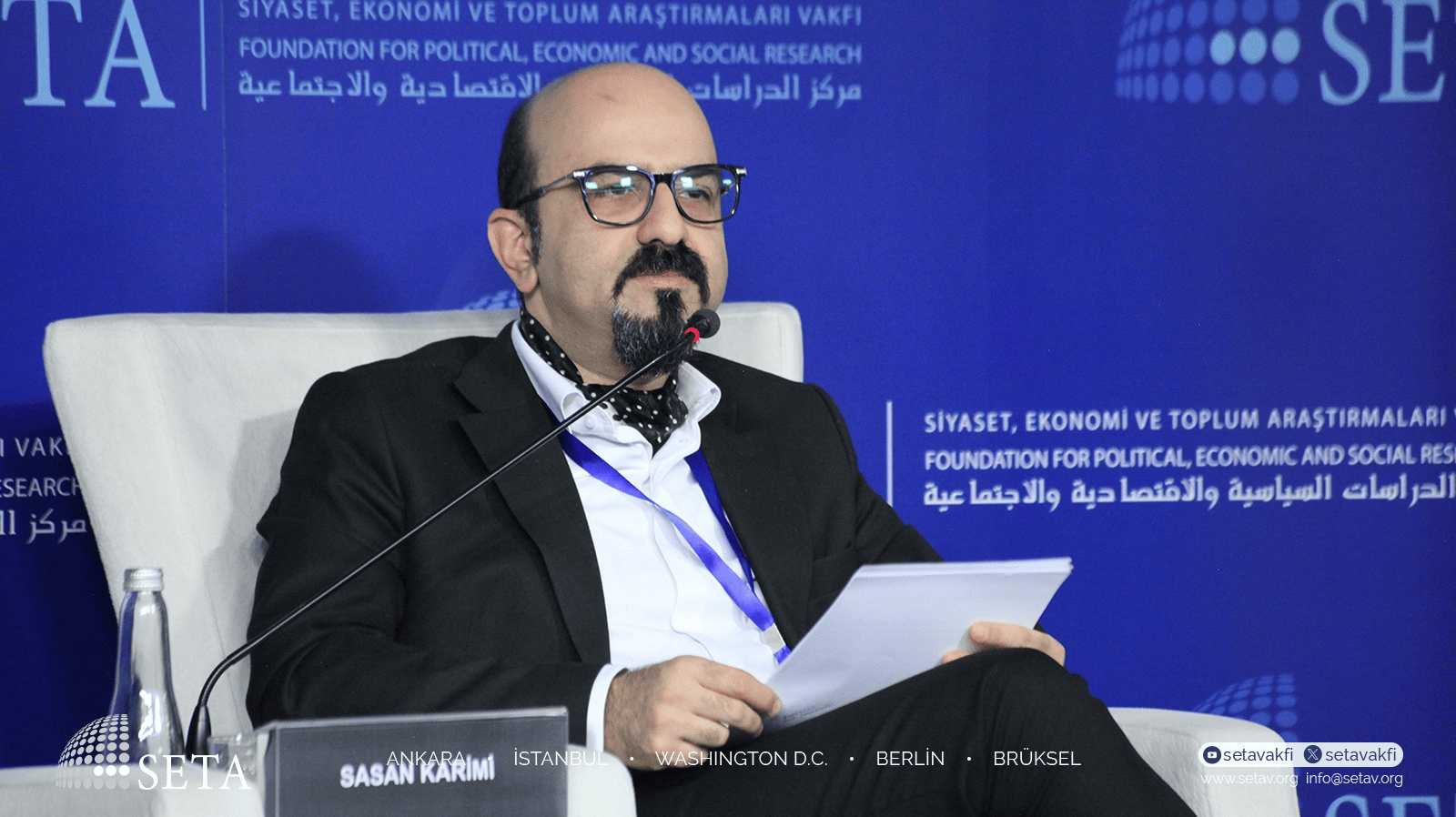
Participating in Forum for Promoting Maritime Security in the Red Sea Gulfs of Aden and Oman in Ankara, dated 14th May 2026, I lectured about the recent war on Iran, and the security of maritime in the Persian Gulf and Strait of Hormuz.
This was held by Arab Center for Security Studies and hosted by SETA institute this year.
Speech text:
“Iranian social psychology is much more complicated than the naïve Americans can understand”. This is a sentence not by me, but one said by Ms. Lambton, a British spy and professor of Iranology, more than 80 years ago. This sentence reminds us of the recent war in which Iranians—including the people, the political system, and even the land—not only resisted actively but defended themselves against two nuclear powers and the world’s most massive military.
But why? Why is Iran as resilient as this? Not now, but thousands of years ago. Resilience is the main factor that determines the outcome of war, rather than military capability.
In this war, many things appeared obvious to everyone: first of all, that the United States is not the only determining player in any game; today's world is a post-hegemony one.
It could not make a regime change, a state collapse, a change in Iran’s borders; nobody escaped, there were no protests or unrest on the streets, no civil war, no fluctuation of power, no chaos, and, most significantly, no surrender.
All American announced goals failed.
Even according to Powell Doctrine standards, Trump’s Iran war (pushed by whispers from Netanyahu) is a complete U.S. failure: no vital U.S. interest, clear goal, and decisive force, public backing, no exit plan and, not a last resort
But no war has absolute winner: Iran also lost its little girls of Minab, its ordinary people, its leaders, significant figures like Ali Larijani, and many military commanders, and suffered major material losses.
The other proved objective is that it is a failed fantasy to put Iran in a corner, hit it, sanction it, ignore it, isolate it, and overcharge it—and then just make money, live safely, and develop other lands fast. It is not possible. This is not because of Iran’s behavior only, but naturally, insecurity does not stop beyond political borders.
Closing the Strait of Hormuz and keeping it closed regardless of announced threats by the U.S. President shows both the will and power of targeting U.S. assets and soldiers, Israeli-occupied land, and whatever country provided logistics, weapons, or intelligence to U.S./Israeli troops.
I think the realistic way of creating sustainable security for this region is through three agreed texts:
- A just non-aggression pact between Iran and the U.S., the guarantee that Iran manifested from the first day that can include all the mutually considerable issues in between. Iran and the U.S. cannot become friends for the foreseeable future. But the active US intrigue and hostility can be over. This is the infrastructure for further agreements.
- The second text, which is useful for making and maintaining security in the Persian Gulf, is to create a “Regional-plus Security Arrangement,” including Iran, GCC countries, Iraq, Turkey, and Pakistan. This arrangement can invite the U.S., China, and Russia as observer members. All security issues, actual or potential, can be resolved by this arrangement, including navigation in the Persian Gulf and passage through the Strait of Hormuz. New regime in the Persian Gulf and the Strait of Hormuz would be just and compliant to the Iran-Oman agreement 1974 and international law.
Of course, Iran has powerful judgment to prefer the strategic interest of this strait rather than economic interests. Iran is now in wartime. It is not possible for President Trump only to reverse the case. These unnecessary strikes have many unintentional consequences. Now Iran asks for reversing all sanctions to reverse the situation of the Strait of Hormuz.
Another idea can be founding a fund, charging the tankers before starting, and saving the money in the fund, which is exempt from any sanctions and will be used for the damages caused by this war.
Such arrangements have been formerly offered by the Iranian government, or figures like HOPE, MWADA, and MENARA, which include all aspects and require updates and attention from all sides.
- The third draft will be a UNSC resolution that terminates all UN sanctions on Iran, emphasizing peace and security in this region.
This will let Trump pretend that this satisfies him. The only dissatisfied player will be Israel, which will whisper closely to Trump. Israel, as the main spoiler, will try to destroy the whole idea.
Iran, GCC countries, the region, the U.S., China, and the whole world will benefit from the stability of the region—but not the Israeli regime, which wants to destabilize the order and then start the propaganda of Greater Israel.
Discussion on the Strait of Hormuz during the Concluding Session
During the open discussion panel on the legal dimensions of the potential closure of the Strait of Hormuz, Dr. Sasan Karimi, assistant professor at the University of Tehran and Deputy for Global Affairs at PAIAB Institute, asked for attention to what he described as the “more realistic dimensions beyond international law” of the issue. He emphasized that matters arising in the real international arena—including issues of international law—should not be analyzed as isolated phenomena detached from temporal and geopolitical contexts; rather, such issues have both antecedents and consequences.
He argued that the issue of the Strait of Hormuz must be understood in relation to repeated acts of aggression against Iran, violations of Iran’s national sovereignty, the killing of 170 children in Minab, and attempts to assassinate Iran’s leader, political figures, and military commanders. He questioned whether these actions did not themselves constitute violations of international law. He further asked whether merely agreeing with his legal interpretation would bring those children back to life.
Dr. Karimi stated that, on the final day of the conflict, Iran had been threatened with being “returned to the Stone Age” and with the destruction of its entire civilization through a potential nuclear attack. He asked whether observers understood what the Iranian people endured on that night. According to him, there was a real possibility that by the following morning no lights would remain on in Iran, no telephones would function, and no heating systems or gas stoves would operate.
He further questioned which country had the courage to provide tangible support to Iran. He argued that mere verbal condemnations—particularly those delivered in hesitant tones—could not be considered meaningful support and were of little practical value. Iran, he stated, did not seek statements of condemnation; rather, it expected countries, allies, partners, and even impartial actors in the international community to uphold their stated principles. However, he argued that fear of the United States prevented such actions.
He therefore asserted that, under such conditions of isolation, others should not expect Iran to strictly adhere to every existing international framework. Responding to criticisms regarding attacks on the opposite side of the Persian Gulf and the closure of others’ territorial waters, he argued that those same territories and waters had been used as launch points for attacks against Iran’s very existence. He maintained that when a country faces an existential threat, it cannot be expected to prioritize compliance with international law, environmental considerations, or similar concerns.
He added that, even if Iran had chosen to comply with such norms, a state subjected to armed aggression remains legally entitled to defend itself. He emphasized that Iran’s foremost priority during wartime—above all else—is the protection of its people and territory.
In conclusion, he criticized the international community for failing to take even minimal procedural action. He stated that states could at least have requested a procedural resolution—one not subject to veto—to convene an emergency meeting on U.S. and Israeli aggression against Iran, or introduced a fair draft resolution in the United Nations Security Council, even if it were ultimately vetoed by the United States. “But nothing was done,” he concluded.


