Essay on Etemad Newspaper July 25, 2021 -
The original text is in Persian and the following translation was done by Ai.
Theoretical perspective: Today, as we are on the verge of handing over the country's executive helm to the winner of the 13th presidential election, and in terms of the negotiations to revive the JCPOA in Vienna, everything is dependent on these changes in Tehran, it is necessary to look at the opportunities and possibly threats facing the 13th government on the issue of the JCPOA and relations with the United States with a slightly more realistic and precise flow chart.
Although both Trump's emergence on the US political scene was an exception and his departure from the White House after one term as president was largely unpredictable, in any case, what happened to us due to his presence in the seat of power in Washington, despite all its exceptionality, followed a predictable generality that is a guide for our future. Similarly, understanding the real order governing the United States and its policy towards Iran and the Middle East can make the opportunities that have arisen and those that have been missed more clear to us than ever before.
If we look at the official positions of countries in the current and official international order, of course, every novice diplomat declares his country's policy towards others as principled, consistent, and most importantly, without paying attention to the details of the domestic policy of the other country. But who doesn't have this on an epistemic and non-official level, and political, social, and economic phenomena inherently affect each other: just as a coup and revolution in one country affect the interests and policies of other countries, the transfer of power in a smaller and more intra-systemic form, such as elections, also casts a shadow on that country's approaches, positions, and decision-making to some extent, and therefore can potentially be meaningful for other governments. Of course, the more dramatic and extreme these domestic developments are and the more challenging the relationship with another country is, the more effective the election's impact on the policy between the two governments will be. At least today, we have been able to clearly and closely observe the example of this meaning in the example of Trump.
The threat that can be encountered in such an epistemological view is distancing oneself from the details of phenomena and reducing a cognitive subject to something like official positions and political pomp: because from a distance, everything looks like everything else. Therefore, what is assumed in this article is that: in politics, due to limitations and conflicts of interest, disputes are generally not a silver lining, and despite everyone's efforts to protect national interests, different parties in a country's domestic politics are determined to achieve this benefit through their own rise to power. Therefore, internal disputes between politicians, parties, and movements in electoral-based political systems are real, and summing up all the different sides of a country's domestic politics, if not for the sake of taking a position or playing with foreign policy, can confront the analyst with a cognitive error and turn his analysis into something like an official statement of the country's diplomatic apparatus, which of course will not function. It is clear that understanding the gaps in domestic politics, the real differences and commonalities, and the turning points of politics and competition within an effective political system that has been the subject of analysis can lead to the production of analyses and ultimately decisions that can be used to reduce damage and identify turning points for gaining and creating benefits for the country.
***
Iran's Domestic Politics - Historical Aspect: Politics, including foreign policy, in the first decade of the revolution was in a special situation both due to the post-revolutionary nature and the warlike nature of the situation. In a period when the Eastern Bloc had not yet collapsed, politics in Iran was largely unified and without pluralism. From this perspective, despite the presence of forces with disparate tendencies in the political system, the burden of the eight-year war and the sensitive conditions of the early days of the revolution required that at least the external and effective lyrics of this scene be largely the same and that no serious and meaningful differences be seen in the external positions of different political tendencies. With the end of the war and the coming to power of the construction government, which openly pursued a specific discourse, especially in political economy and also, in the first place, in foreign policy, other approaches also began to reconstruct themselves and clarify the discursive boundaries. The primary motivation for such positions, intellectual organizations, of course, was the desire and enthusiasm of various tendencies to be present and successful in the upcoming turning points: something that is, frankly, inherent in every individual and political movement.
Among them, some represented a free economy, while others believed in a more state-owned economy. Some movements were optimistic about de-escalation and normalization of foreign relations, while others looked more inward. Some liked the East more, and some groups assessed the West as having the main political and economic aspects in the world game of the day.
In addition, compared to the first decade, just as a fundamental event had occurred in the global arena and there was no longer any talk of a bipolar world, the war had also ended and the equations in Tehran had also changed. The currents were moving away from their initial origins to some extent, and little by little the most left-wing now advocated for expanding interactions with the West, while the proponents of a free market economy were mixing right-wing politics with a semi-state and semi-private economy, and the scene was not very clear according to the political and economic definitions of the day.
Above all, from the beginning of the reform government, these meanings became clear in all factions, and by the end of their studies, the scholars of the different streams of the now changed approaches approached a certain maturity in various political, economic, and foreign policy dimensions, and each stream seriously advocated a certain type of view.
Of course, over the past twenty-four years, these streams have also been constantly evolving, and now they may not be called fundamentalist and reformist in the style of the past, but in any case, the main approaches are clear in most of these streams: even if individuals and sub-streams under them have adopted changes of direction as tactics or strategies at times.
In this regard, it should be noted that the author no longer believes in the previous titles in categorizing the various political circles in Iran, and today divides the currents beyond their previous titles into extremist and moderate in terms of method and character, which may not even be consistent and consistent with what is being discussed in the rumors in some instances.
***
Iran and America: But how can one reach an analysis on the subject of foreign relations, and especially on the specific issue of the relationship between Iran and America? Regardless of the attributes that the governments of each of these two countries attribute to the other and describe the dominant policy with official but reductionist positions, the focus of this note is ultimately on accessing an analysis in the context of history that can be used to fuel new decision-making.
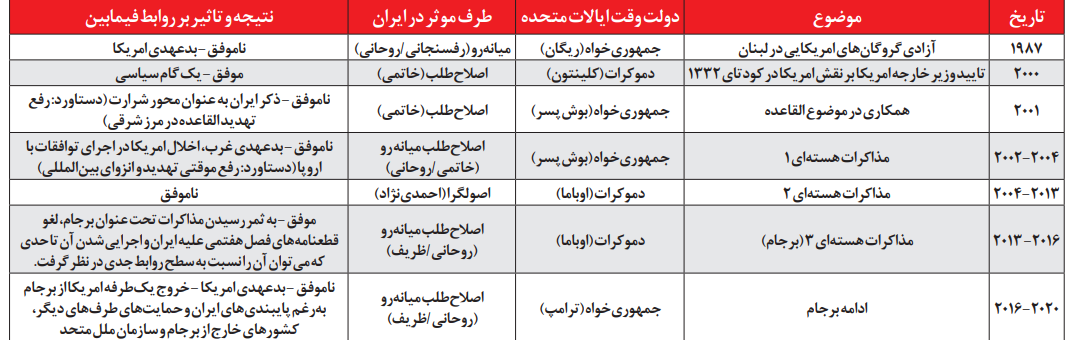
At least as far as is available in official history, a few examples can be listed in the past forty-two years (the period of severance of official and permanent diplomatic relations) between the two countries and considered as practical and real cases between them:
***
Analysis: By reviewing the very brief list at the end of the page, the pattern can be assessed as follows:
- Relations between the two countries after the revolution have been mainly a history of failure and distrust. This distrust is, of course, rational given the US government's failures.
- If successful or semi-successful results have been achieved in relations between the two countries, they have mainly been between a democratic government in the US and a moderate party in Iran.
- Failures in many cases have been either due to the lack of the above pattern (Republican in Washington and/or conservative in Tehran) or the change of the US government from a democratic to a Republican government. We can see the scene as follows: due to regional alliances and also the interests of the Republicans in large arms deals in the Middle East, recording and continuing successful cases in relations with the Islamic Republic of Iran is not in their favor. Therefore, especially with the end of the Iran-Iraq War and the collapse of the Eastern Bloc, Republicans have always been opposed to strengthening the base and successes of the moderates in Iran. This opposition is, of course, due to their partisan interests within the United States (i.e., disrupting any achievements of the Democrats in this field) and also in their relations with the people of the region: relations that are more visible today than in the past with the changes in the scene between the Arabs and Israel.
On the other hand, Democrats, firstly due to their competition with Republicans in American domestic politics and then due to their apparent origin on the issue of human rights, etc., see the possibility of cooperating with Iranian moderates as possible and permissible compared to the political systems of the region. In addition, in its foreign policy, if the Democratic Party can rebuild relations with Iran to a reasonable extent, it will be able to sell it to the public opinion of this country as a winning card in its portfolio and resolve and manage one of the old tensions of American foreign policy.
However, this is and seems to be more possible both in terms of the discourse that the Democratic Party represents at the macro level and in terms of technical and operational compatibility between the reformists and moderates traditionally and conceptually. Republicans are also trying to prevent this potential achievement of their domestic rivals or even destroy it. Therefore, it must be concluded that not all internal forces in US politics are the same and their differences on various issues, including relations with the Islamic Republic of Iran, are significant. This difference does not stem from a better temperament but from partisan interests and internal rivalries: both the Democrats’ desire to reach an agreement and repair relations with Iran is in their partisan interests and the Republicans’ underhandedness. Professional politics is not an inherent, permanent, and unreasonable policy of friendship and enmity. Rather, actions are solely aimed at a result to acquire, consolidate, and develop power at various levels.
***
Conclusion: What should be considered in the thirteenth government of Tehran as a point in the minds of decision-makers and decision-makers is that we all agree that Iran’s foreign policy is more supranational than in the past due to the construction of power, and therefore adopting procedures that lead to de-escalation at the international level can disrupt the above order in the relationship between Iran and the West, especially the United States, and change the image of the government to a moderate fundamentalist one. This means that in addition to maintaining their discursive and current principles, they will also make optimal use of what is at hand and complete the constructed structure in line with national interests and within supranational frameworks. At the technical level, it is better for the new government to be able to and insist on using qualitative forces at different levels - regardless of their political origins.
File