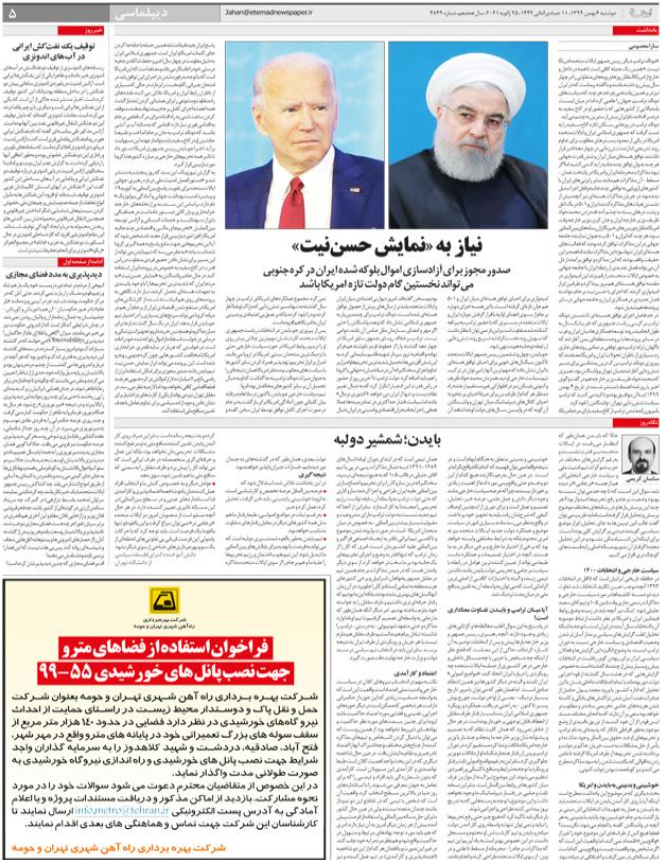
Now that Biden has come to power in the United States as expected and, despite the different tendencies in the Democratic Party, his chosen national security and foreign policy team has been seen as the most “pro-JCPOA” of all, the question is to what extent can we hope for an improvement in the JCPOA situation and the lifting of sanctions? Although this question has been the subject of questioning and analysis many times and in various media outlets, it can be roughly said that most of these explanations, rather than analysis, have been expressions of the speaker’s political position based on a general tendency. In order to avoid repeating this mistake and not getting caught up in it again in this analysis, we will divide the main issue into smaller parts:
Foreign Policy and the 1400 Elections:
It is in the historical memory of Iranians that, at least in the 1392 elections, what determined the outcome of the elections was the difference in the views of the two groups of candidates on foreign policy and the official negotiations currently underway (between the 5+1 and Mr. Saeed Jalili’s team).
Now, what should be considered in the context of the current state of relations between Iran and the United States is its two-way connection with next year's elections in Iran. Given that the analysis of most political trends is centered on the easier economic and foreign policy situation compared to the Trump era, it is clear that the motivation of these trends and Iranian political activists to steal the ball of competition in the upcoming elections is much greater than it was a few months ago. In particular, the tendencies that have been far from the executive branch of the government in the past eight years, with all their internal differences, with the analysis that running the country will be easier and more desirable with the re-inflow of money from oil exports, the facilitation of banking transactions, and the reduction of the costs of sanctions, are trying to seize the seat of this power in various ways: from injecting extreme despair about the current situation (as if there was no such thing as a phenomenon called Trump and his sanctions against international law) and despair of solving problems by the current government and the lifting of sanctions by the United States, to fueling statements that suggest unity in favor of negotiations, as well as the short-term nature of the current government.
Optimism and pessimism about Biden and America:
Another debate that is raised in the subject of this note is whether, with Biden coming to power in the United States, we should be optimistic about Biden and fulfilling his election commitments to return to the JCPOA, or should we view everything said or done in Washington with pessimism? Certainly, no one on either side of this issue considers themselves anything other than “realists,” but the truth is that if it were clear what reality is and what realism is, there would be no problem and no difference in the middle. Optimism and pessimism belong to the era of ambiguity, and as a result, it is not really possible to know which view is more realistic.
At the same time, in the author’s opinion, neither of these two aspects, nor even the alleged realism, are of great importance. Because the field of foreign policy, like other aspects of scientific knowledge and practice, is the field of news, analysis, decision, and action, and in order to avoid such qualitative characteristics as described above, one must equip oneself. In fact, it seems that, like many things in politics, the position and performance of the new United States government are not inevitable but will depend on various conditions, some of which are beyond our control and others in our hands. What is at our disposal in terms of decisions and actions can naturally be one of the most decisive factors in relation to the Biden administration's JCPOA and sanctions policy: having an expert team, and of course with sufficient authority, is one of the main requirements through which we can approach securing national interests in the medium term.
However, as can be easily understood by reviewing very recent history - that is, from the end of the George W. Bush administration until now - the performance and approach of the Islamic Republic of Iran have been remarkably flexible in proportion to the behavior of the other party. In any case, it should not be forgotten that the same system as a whole, with whose decision and support our Foreign Minister met and negotiated directly with the US Secretary of State fifty-odd times during the Trump era and after his norm-breaking behavior, prevented the two ministers from meeting. Therefore, despite the fixed principled positions, behavior and approach are adjusted according to the conditions and tactical and strategic interests. This is also, of course, a matter of customary norms between countries in international relations.
Therefore, there will be no fixed and rigid version in our diplomatic behavior, and this matter will be designed and implemented according to the contexts that gradually emerge.
Therefore, since the new team has much greater international legitimacy and acceptance than the Trump administration - especially among America's allies -, if the issue is reversed and the Iranian team fails, it will be able to create a comprehensive and international consensus against our country: something that will make things more difficult for us than under Trump, who was only able to impose and implement unilateral sanctions.
On the other hand, we remember that during the JCPOA negotiations, this same team stood up to the Republicans, Israel, and some Arab countries in the region and pushed the work forward. At that time, they had not become better people, but it was we who behaved more professionally and forced the other side to comply with our wishes.
Another thing is that just as we once decided to enter into negotiations with the Obama team and even make commitments, but - rightly - we did not consider Trump worthy of exchanging messages, the other side is not obliged to reach a conclusion with any current or approach from Iran. Therefore, utmost care must be taken in selecting the political team in the government and the Ministry of Foreign Affairs.
Trust and efficiency:
The important point in selecting major forces in foreign policy and national security is trust. The reality is that due to the great sensitivity of this area of governance, not every person who may be trusted by the government in other executive, legislative, and judicial areas will necessarily be suitable for such positions desired by the government and relevant institutions. That is why, by following individuals and negotiating teams from different factions, we can find their common ground in the complete trust of the leadership and the system in them.
At the same time, another characteristic that is of great importance in this discussion is, of course, the ability and efficiency of these officials. Efficiency that, without sloganeering, should be selected at the highest level in the individuals and teams that are introduced to the world for interaction with today's standards. The reality is that the person or team that is at the intersection of these two graphs is not very numerous, but at the same time, our country needs it more than ever today to solve international problems and take advantage of the opportunity that has arisen: a matter that must both be taken into account by the relevant and responsible institutions in the government and attract the attention of the people. Otherwise, and with the lack of either of these two characteristics (reliability and efficiency) in the acting team and the next government, as we have seen in the recent past, the losses will be irreparable.
Etemad link

File