Interview with Shargh Newspaper, May 24, 2025 -
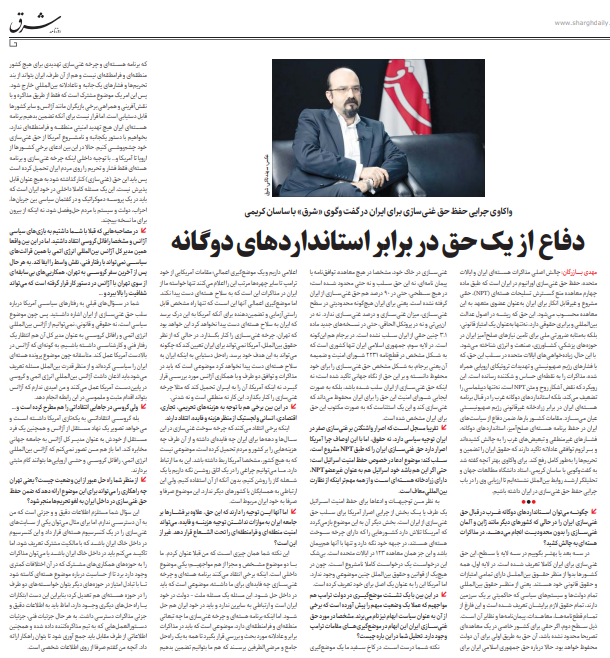
The interview was in Persian and the translation below was done by Ai.
Analysis of why Iran should preserve the right to enrich in an interview with Shargh with Sasan Karimi
How can the West's double standards regarding Iran's right to enrich while other countries such as Japan and Germany are enriching without restrictions be challenged in the nuclear negotiations?
In three dimensions, or rather, in three layers or levels, this right to enrich is fully defined for Iran. In the first layer, all countries initially have all their privileges and legal rights from the perspective of international law. That is, from the perspective of international law, all governments and political systems that have sovereignty over a territory have all the necessary rights defined for them, and this is regardless of all resolutions, treaties, agreements, and the like. Under the second level, if a right for a particular country is not explicitly limited in a treaty, that right will be reserved for that state in the first way. Now, regarding the right of the Islamic Republic of Iran to enrich on its territory, specifically in no treaty, agreement or treaty, this right has not been denied or even limited; at no level, not even at 90 percent, has Iran been deprived of the right to enrich.
That is, there is no restriction for Iran on the level of enrichment, the amount of enrichment, and the percentage of enrichment. Neither in the NPT nor in the Additional Protocol, not even in the new versions of Article 3.1 has such a right been denied from Iran. This is also the case in the JCPOA. In the third layer, the Islamic Republic of Iran is the only country that has explicitly reserved the right to enrich for itself in Security Council Resolution 2231 and its annex, the JCPOA, and this right has been emphasized from a global perspective; Not that Iran has been denied the right to enrich, but rather the Security Council affirmatively reserves the right for Iran to enrich, and this is an exception that has been specified in writing for Iran.
It is almost certain that Washington's insistence on zero enrichment in Iran has a political justification, not a legal one. However, why does the US insist on denying Iran the right to enrich, which is legitimate under the NPT? The claim is about preserving Israel's security; even if this is the case, Israel itself, as a non-member of the NPT, has a nuclear arsenal and, most importantly, is exempt from international supervision.
In my opinion, the justifications and claims to preserve Israel's security are one side or part of why the US insists on denying Iran the right to enrich. The other part of it goes back to the fact that the US is trying to keep countries that have a nuclear fuel cycle on its side and be allies only with them, and this is part of the 123 treaty in the United States. This request is undoubtedly a completely illegitimate request. Because there is no such issue in any of the international laws and regulations. But the United States has defined this as a principle for itself.
In the meantime, we are also faced with a divergence of positions in the Trump administration, which has practically created an ambiguous situation, which some also call the policy of ambiguity. Specifically, regarding Iran’s right to enrich uranium, this ambiguity exists in the positions of Trump officials. What is your analysis on this?
Your point is correct. In the White House, we have a declarative position and a practical position; American officials, from Trump himself to other figures, regularly declare that our only demand from Iran in the negotiations is that it not obtain a nuclear weapon. But their practical position is that the only specific, verifiable and guaranteed way for the United States to understand that Iran will not obtain a nuclear weapon will be for Tehran to abandon the enrichment cycle. While in terms of international law, the United States cannot determine for Iran how it can achieve this goal. The solution to ensure that Iran does not acquire a nuclear weapon is an issue that must be examined in negotiations and agreements between the two sides and in cooperation with the Agency, not for the United States to impose it on Iran, for example, to abandon the enrichment cycle. This is neither logical nor feasible.
Meanwhile, some are critical, considering the sanctions, commercial, economic, human and logistical costs from a cost-benefit perspective.
The fact that some criticize what benefit the enrichment fuel cycle has had for Iran in these years and decades and what costs it has imposed on the country and its people is not a matter that concerns any country, especially the United States. This concerns us. We can keep a light on in a room or light a gas flame without using it. But this has nothing to do with our neighbors or other countries. This issue is solely and exclusively related to Iran itself.
But they have the justification that this right, in addition to putting pressure on Iranian society and not justifying the cost and benefit, could overshadow regional and trans-regional security. Is it different?
Your point is the same as what I mentioned earlier. We are facing two specific and separate issues; one is an internal issue. The fact that some criticize the nuclear program and the enrichment cycle for what benefit they have brought us is an issue that must be resolved internally. This issue is a nation-state issue within Iran itself and has nothing to do with others, and it must be resolved within Iran itself. But what regional and trans-regional consequences our nuclear program and enrichment cycle have is an issue that must be discussed and examined in equal and fair negotiations so that everyone can reach a comprehensive and mutually acceptable solution that will allow us to guarantee that our nuclear program and enrichment cycle do not pose a threat to any regional or trans-regional country, and that Iran can be freed from unilateral and unfair international sanctions and pressures. So this is a common issue that can only be achieved through negotiations and with the role and support of some actors such as the Agency and other countries.
But we are not going to give up our right to enrich in response to the unilateral and illegitimate order of the United States in order to guarantee that Iran’s nuclear program does not pose any regional or trans-regional security threat. Now, in the meantime, the claim of some countries from Europe to the United States, etc., with the internal justification that the enrichment cycle and nuclear program have only imposed pressure and sanctions on the Iranian people, so this right (enrichment) should be set aside, is absolutely unacceptable. This is a completely internal issue in Iran itself that must be resolved in a democratic process and in a political dialogue between the currents, parties, the government and the system with the people, not by having them dictate to us from the outside.
In previous interviews with you, you criticized the political games of the Agency and specifically Rafael Grossi. But in the meantime, this very Director General of the International Atomic Energy Agency, with these political interpretations, cannot really play the role of an intermediary with technical behavior. In any case, after Grossi's last visit to Tehran, unprecedented cooperation has been put on the agenda by Tehran with the Agency, which can increase transparency and...
In previous questions, you referred to the political behavior of the United States regarding the deprivation of Iran's right to enrich. So, since the issue is political, not legal, we cannot expect technical and expert behavior from the International Atomic Energy Agency and Rafael Grossi as Director General, in such a way that the Agency acts upstream of the United States. Unfortunately, since the issue of the Iranian nuclear file has been politicized and the issue is defined from the perspective of international power, it must be acknowledged that the International Atomic Energy Agency and Grossi are acting downstream of the United States, and I have no hope that the Agency will be able to take positive and tangible action in this regard.
But Grossi has also raised criticisms in some places and...
Yes, Grossi has criticized the unilateralism of the United States and wants to convey to the international community the image of an institution independent of the Agency and also an independent person from himself as Director General of the Agency. But again, I do not think that the International Atomic Energy Agency, Rafael Grossi, and even the Europeans can take a positive step.
From your perspective, what is the solution to overcome this situation? What solution can Tehran offer for this issue that will lead to the lifting of sanctions while preserving the right to enrich inside Iran?
Your question requires detailed and detailed information that I do not have access to. But for example, one of the enrichment sites could be placed in a nuclear consortium and this consortium could be within Iranian territory, defined by joint ownership, but I emphasize that it should be within Iranian territory, or the negotiations could be moved to areas of joint cooperation where there are fewer differences, in order to reduce the sensitivity of the nuclear issue, so that by exchanging concessions in other areas, the demands of both sides in the nuclear field can be adjusted; therefore, there are other such initiatives or solutions, but we must have access to detailed and detailed information about the negotiations. In any case, technical details, details of the instructions given to the negotiating team, as well as information from the other side, must be collected in order to be able to offer a solution. What I said is purely based on personal information.
Website Link

File