The book "The Challenge of Knowledge and Perception in the Foreign Policy of the Islamic Republic of Iran" by the authors: Dr. Mohammad Javad Zarif and Dr. Sasan Karimi was published in June 2026 by Tehran University Press.
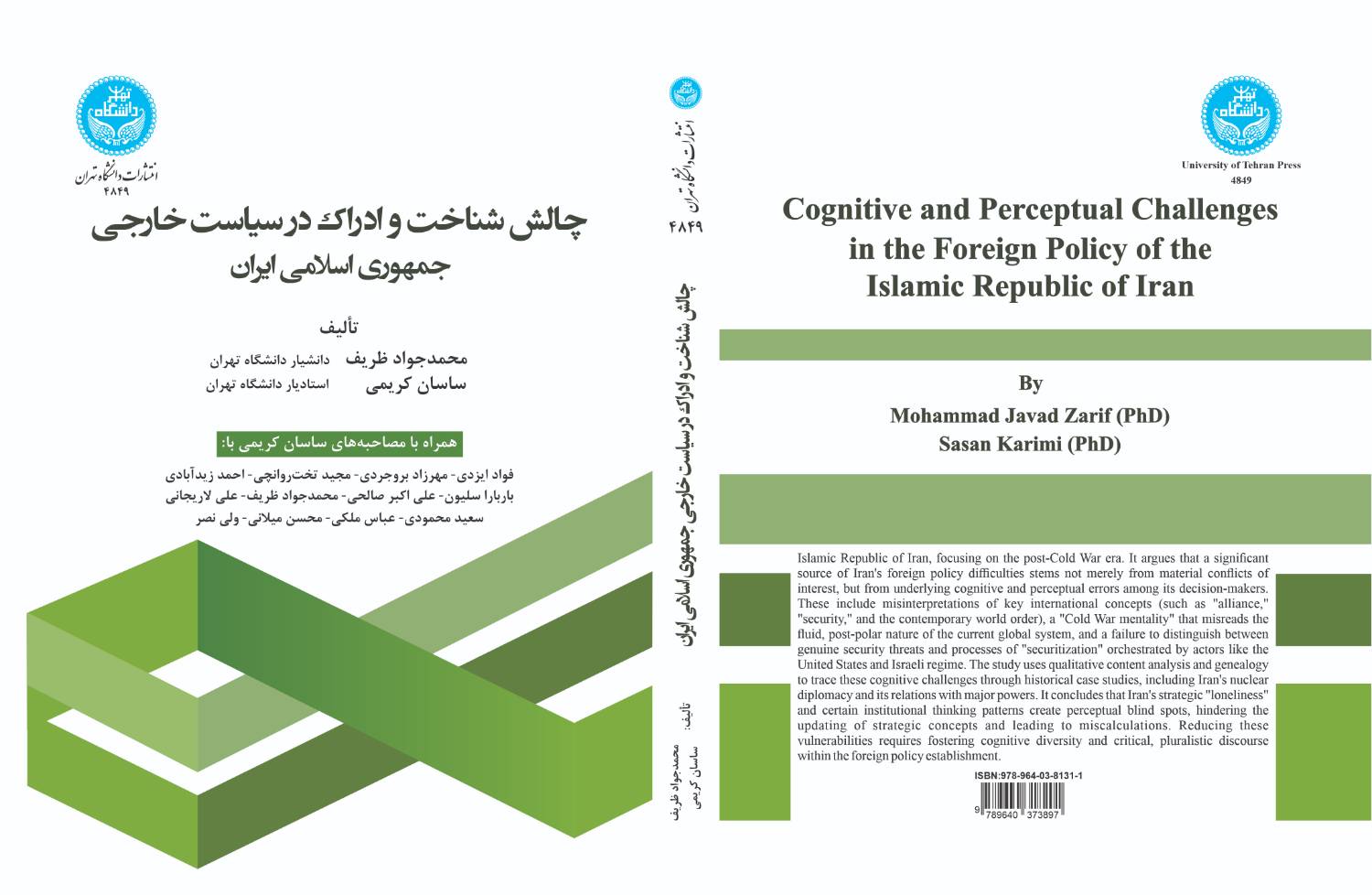
According to the Public Relations Department of the University of Tehran, the book “The Challenge of Cognition and Perception in the Foreign Policy of the Islamic Republic of Iran,” co-authored by Dr. Mohammad Javad Zarif, Associate Professor of the Faculty of World Studies at the University of Tehran and former Minister of Foreign Affairs, and Dr. Sasan Karimi, Assistant Professor of the Faculty of World Studies, was published and put on the market in June 2026 by the University Press.
This book, which is the result of extensive research, uses an innovative approach to examine the origins of Iran’s foreign policy challenges, focusing on relations with the United States during the transition period of the international system. By raising the fundamental question of whether these challenges have roots at the level of agency, decision-making, or identity structures, the authors examine the deeper issue of the “cognitive challenge.”
The authors of this book believe that a significant part of the challenging performance in the field of foreign policy is due to images and perceptions that do not correspond to reality. “Lack of resources and appropriate mechanisms, while not being aware of it,” as a cognitive problem, has provided a serious obstacle to a correct understanding of the new world order and fundamental concepts such as “unity,” “coalition,” and “security.”
This book is dedicated in five chapters to theoretical and methodological discussions, various dimensions of the cognitive challenge, and objective examples of disagreements in the understanding of key concepts of international relations. An important part of this work is dedicated to detailed conversations with prominent figures and experts in the field of Iranian foreign policy who provide first-hand experiences and diverse analyses of various political tendencies; among these figures, we can mention Dr. Fouad Izadi, Dr. Ali Akbar Salehi, Martyr Dr. Ali Larijani, Dr. Mohsen Milani, and Dr. Vali Nasr, who have provided their perspectives to the audience.
The authors of the book emphasize that the world is experiencing a “new post-polar order” and that the continuation of the Cold War era or the unipolar illusion is a serious obstacle to effective and up-to-date policymaking in Iran. This work aims to provide a clear mind and insightful perspectives for students, practitioners, and researchers of foreign policy, so that while identifying the roots of the challenges, a step can be taken towards opening new perspectives in this field.
Book introduction on University of Tehran

Book purchase link from Fidibo